Keeping your pet's environment clean is an important part of responsible pet ownership. Floors, crates, litter areas, cages, feeding stations, toys, and other frequently used surfaces can accumulate dirt and microorganisms over time.
But when it comes to disinfectants, more powerful does not automatically mean better.
A disinfectant that is suitable for one surface may be inappropriate for another. Some products require dilution, some need a specific contact time, and some should never be used around certain animals.
The safest approach is to choose a product based on its intended use, label instructions, dilution requirements, contact time, and safe storage instructions.
Most importantly, remember that disinfectants are designed for surfaces—not for applying directly to your pet.
What Is the Difference Between Cleaning and Disinfecting?
Cleaning and disinfecting are related but different processes.
Cleaning removes dirt, food residue, debris, and many microorganisms from a surface.
Disinfecting uses a chemical product to kill specified microorganisms on a surface.
The CDC explains that cleaning is usually sufficient for many pet items, while disinfection can be an additional step in situations where it is needed.
For example, if a pet bowl simply has leftover food, routine washing may be all that is necessary.
Disinfection may become more relevant when:
- A pet is sick
- An item has been contaminated with urine or feces
- There is a specific infection-control concern
- A veterinarian recommends additional hygiene measures
- Certain higher-risk animals or household situations require additional precautions
Don't automatically disinfect everything every day. Choose the level of cleaning appropriate for the situation.
1. Check the Intended Use
The first thing to check on a disinfectant is where it is actually designed to be used.
A product may be intended for:
- Hard surfaces
- Floors
- Kennels
- Cages
- Litter-area surfaces
- Equipment
- Food-contact surfaces
- Bathrooms
- Other specific materials
Never assume that a product suitable for one surface is automatically suitable for another.
EPA guidance emphasizes that disinfectant labels specify where and how a product can be used.
Before buying, ask:
Is this product specifically intended for the surface I need to disinfect?
That simple question can prevent many unnecessary mistakes.
2. Read the Entire Product Label
The label isn't just packaging.
It contains important instructions about:
- Where the product can be used
- How much product to apply
- Whether dilution is required
- How long it needs to remain on the surface
- Whether rinsing is necessary
- Required protective equipment
- Storage requirements
- First-aid information
- Warnings about pets and children
The EPA recommends reading the label before buying, storing, and using household cleaning products.
If you don't understand how a disinfectant should be used, don't guess. Check the manufacturer's instructions first.
3. Understand Dilution Instructions
Some disinfectants are ready to use.
Others are concentrated and must be diluted before application.
If a product requires dilution, follow the manufacturer's instructions precisely.
Don't assume:
"More concentrated means more effective."
Using too much product can create unnecessary chemical exposure and may damage certain surfaces.
Using too little may mean the product does not perform as intended.
The EPA specifically advises preparing products at the correct strength when dilution is required.
Always Measure Carefully
If dilution is required:
- Use the specified amount of product
- Use the recommended amount of water
- Follow the manufacturer's measuring instructions
- Prepare only the amount you need when appropriate
- Label any permitted prepared solution
- Never improvise the concentration
And never mix disinfectants together.
4. Pay Attention to Contact Time
Contact time is one of the most commonly overlooked parts of disinfecting.
A disinfectant usually needs to remain on the surface for a specified amount of time to work effectively.
Simply spraying a product and immediately wiping it away may not provide the intended disinfection.
The EPA explains that contact time is the period the product must remain on the surface for it to be effective.
The CDC similarly advises following the label's stated contact time and keeping the surface wet for the required period.
Think of It This Way:
Apply → Keep the surface wet for the required time → Complete the next label-directed step → Allow appropriate drying
Always follow the specific product label rather than assuming that every disinfectant works for the same amount of time.
5. Clean Before You Disinfect
Disinfecting a visibly dirty surface isn't always the best first step.
Food, dirt, grease, and organic material can interfere with the performance of some disinfectants.
The CDC recommends cleaning surfaces before disinfection when appropriate.
A practical routine is:
Remove debris → Clean → Rinse if required → Disinfect → Follow contact time → Rinse or wipe if instructed → Dry
This is especially important for surfaces exposed to food, feces, urine, or other organic material.
For pet areas that frequently experience accidents, consistent cleaning is essential. Our guide on House Training (Potty Training) also discusses the importance of thoroughly cleaning indoor accidents because lingering odors can encourage repeat accidents.
6. Consider Your Pet Species
Not every disinfectant is appropriate for every animal.
This is particularly important if you own:
- Cats
- Dogs
- Birds
- Rabbits
- Guinea pigs
- Hamsters
- Rats
- Reptiles
- Amphibians
- Other sensitive species
For example, the CDC specifically warns that disinfectants containing phenols are very toxic to cats. It also advises extra caution around birds because disinfectant fumes can harm their sensitive respiratory systems.
So don't simply search for a product labeled "pet-safe."
Ask:
Safe for which pet, which surface, and under what conditions?
That is a much better question.
For owners of small animals, our guide on Best Small Pet Products Every Owner Needs covers cleaning and hygiene supplies as part of creating a suitable everyday environment.
7. Keep Pets Away While Disinfecting
One of the most important safety rules is simple:
Keep your pet away from the area while you are cleaning and disinfecting.
Pets should not be allowed to:
- Walk through wet disinfectant
- Lick treated surfaces
- Touch wet products
- Drink from containers holding cleaning solutions
- Breathe concentrated fumes unnecessarily
The CDC advises keeping pets away from disinfectants during use and following label instructions regarding when animals can safely return.
Some disinfectants may be safe around pets after they have dried, but this depends on the specific product.
Never assume.
Check the label.
8. Never Apply Disinfectant Directly to Your Pet
This point deserves special attention.
Household surface disinfectants should not be used as pet grooming products.
Do not spray disinfectant onto:
- Fur
- Skin
- Paws
- Eyes
- Mouth
- Ears
The CDC explicitly states that disinfectants should not be used to wipe or bathe pets.
If your pet needs a medical or skin-cleaning product, use a product specifically intended for animals and follow veterinary guidance.
9. Be Especially Careful Around Food and Water Areas
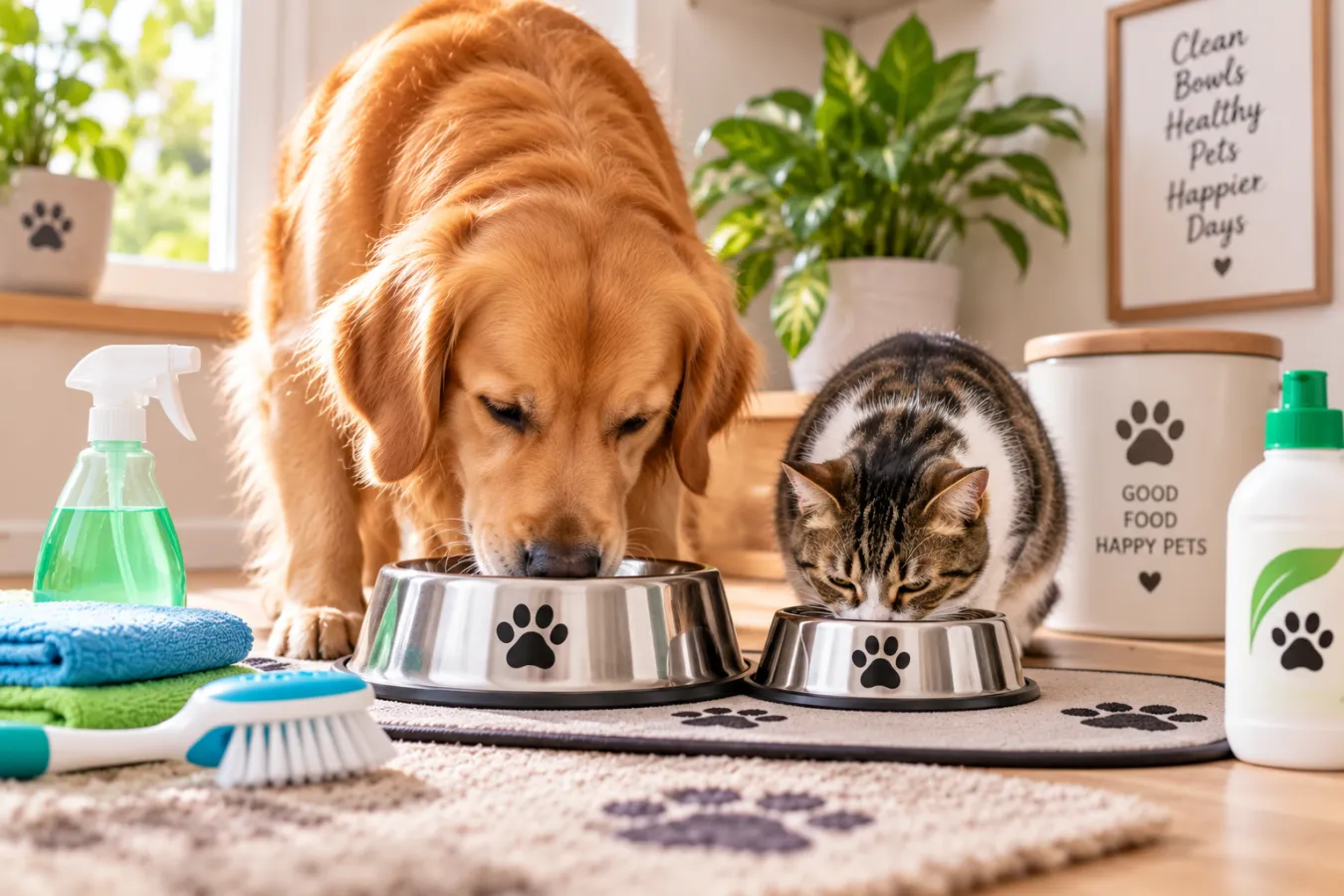
Pet feeding areas require extra consideration because food and water come into direct contact with bowls and feeding surfaces.
If you're disinfecting a feeding area:
- Remove food and water bowls.
- Remove visible food debris.
- Clean the surface.
- Use only a product approved for the intended surface.
- Follow the label's dilution and contact-time requirements.
- Rinse when the label requires it.
- Allow the area to dry appropriately.
- Return clean bowls only when the area is safe to use.
If you're also working on improving your pet's overall feeding setup, our guide on How to Choose the Right Cat Food for Your Pet provides additional guidance on choosing food according to your cat's nutritional needs.
10. Choose Products According to the Surface
Different surfaces can react differently to disinfectants.
Before using a product, check whether it is appropriate for:
- Stainless steel
- Plastic
- Ceramic
- Rubber
- Painted surfaces
- Wood
- Fabric
- Upholstery
- Sealed flooring
- Unsealed materials
Some disinfectants can damage finishes, discolor materials, or leave residues.
EPA guidance recommends checking label instructions for compatible and incompatible surfaces.
Never assume that a product labeled "disinfectant" is suitable for every material in your home.
11. Don't Mix Cleaning Products
This is one rule you should never ignore.
Never mix disinfectants with other cleaning products unless the manufacturer specifically instructs you to do so.
In particular, never improvise combinations involving bleach and other chemicals.
The CDC warns that mixing bleach with cleaners such as ammonia can produce dangerous toxic gases.
The EPA also advises against mixing cleaning products because chemical reactions can produce toxic vapors.
When in doubt:
One product at a time. Follow the label.
12. Store Disinfectants Safely
Choosing a suitable disinfectant is only half the job.
You also need to store it correctly.
Keep disinfectants:
- In their original containers
- With the labels intact
- Tightly closed
- Away from pet food
- Away from water bowls
- Away from children
- Out of your pet's reach
- Away from incompatible chemicals
- According to the manufacturer's storage instructions
The EPA recommends keeping cleaning products out of reach of pets and children and retaining them in their original containers.
Never transfer disinfectants into drink bottles, food containers, or unlabeled bottles.
A familiar-looking container can create a serious accidental-ingestion risk.
13. Don't Store Disinfectants Near Pet Food
Your cleaning products and your pet's food should have clearly separated storage areas.
Avoid keeping disinfectants:
- Beside food bags
- Above food bowls
- Near treat containers
- Next to water bowls
- In cabinets where pets can reach them
The EPA specifically advises not storing cleaning or pesticide products near pet food or water dishes.
A separate, secure storage location is a much safer choice.
14. Consider Ventilation
Some disinfectants produce fumes that can irritate people or animals.
When the product label recommends ventilation, follow those instructions.
Depending on the product and setting, this may mean:
- Opening windows
- Increasing airflow
- Using appropriate ventilation
- Keeping pets in another room
- Allowing the area to air out before re-entry
This is especially important for birds and other animals with sensitive respiratory systems.
The CDC specifically recommends extra caution with disinfectant fumes around pet birds.
15. Don't Assume "Natural" Means Safe
A product marketed as:
- Natural
- Plant-based
- Green
- Chemical-free
- Eco-friendly
isn't automatically safe for every pet.
Safety depends on the actual ingredients, concentration, intended use, exposure route, and directions.
The same principle applies to homemade cleaning solutions.
The CDC notes that vinegar is often promoted as a natural disinfectant, but there isn't enough evidence to establish it as a reliable way to disinfect pet items.
Read the actual instructions instead of relying only on marketing language.
16. Know When Cleaning Is Enough
One of the best ways to reduce unnecessary chemical exposure is to avoid disinfecting when ordinary cleaning is sufficient.
For many everyday situations:
Soap + water + scrubbing + rinsing + drying
may be all you need.
Disinfection becomes more relevant when there is a specific reason to reduce microorganisms beyond routine cleaning.
The CDC notes that cleaning alone is usually sufficient for most pet items, with disinfection used in certain circumstances.
This makes your routine simpler and helps avoid unnecessary product use.
17. Pay Attention to Your Pet's Health Situation
Some situations may require more careful cleaning and disinfection.
Consider additional precautions if:
- Your pet is sick
- Your pet has a contagious infection
- There has been fecal contamination
- There has been urine contamination
- A household member has increased vulnerability to infection
- Your veterinarian recommends additional hygiene measures
The CDC recommends more frequent cleaning and disinfection when pets are sick or when certain higher-risk circumstances exist.
If you aren't sure what level of disinfection is appropriate for an illness, ask your veterinarian.
18. Check Whether the Product Is Registered or Approved for Its Intended Use
Where applicable, look for the regulatory information required in your country.
For products regulated as disinfectants in the United States, EPA registration and label directions provide important information about approved uses and microorganism claims.
However, regulatory systems differ between countries.
If you live outside the United States, check the relevant national authority and use products according to local requirements.
The important point is to choose a product with clear, verifiable instructions for its intended purpose.
19. Keep the Right Cleaning Tools Nearby
A disinfectant is only one part of a good cleaning system.
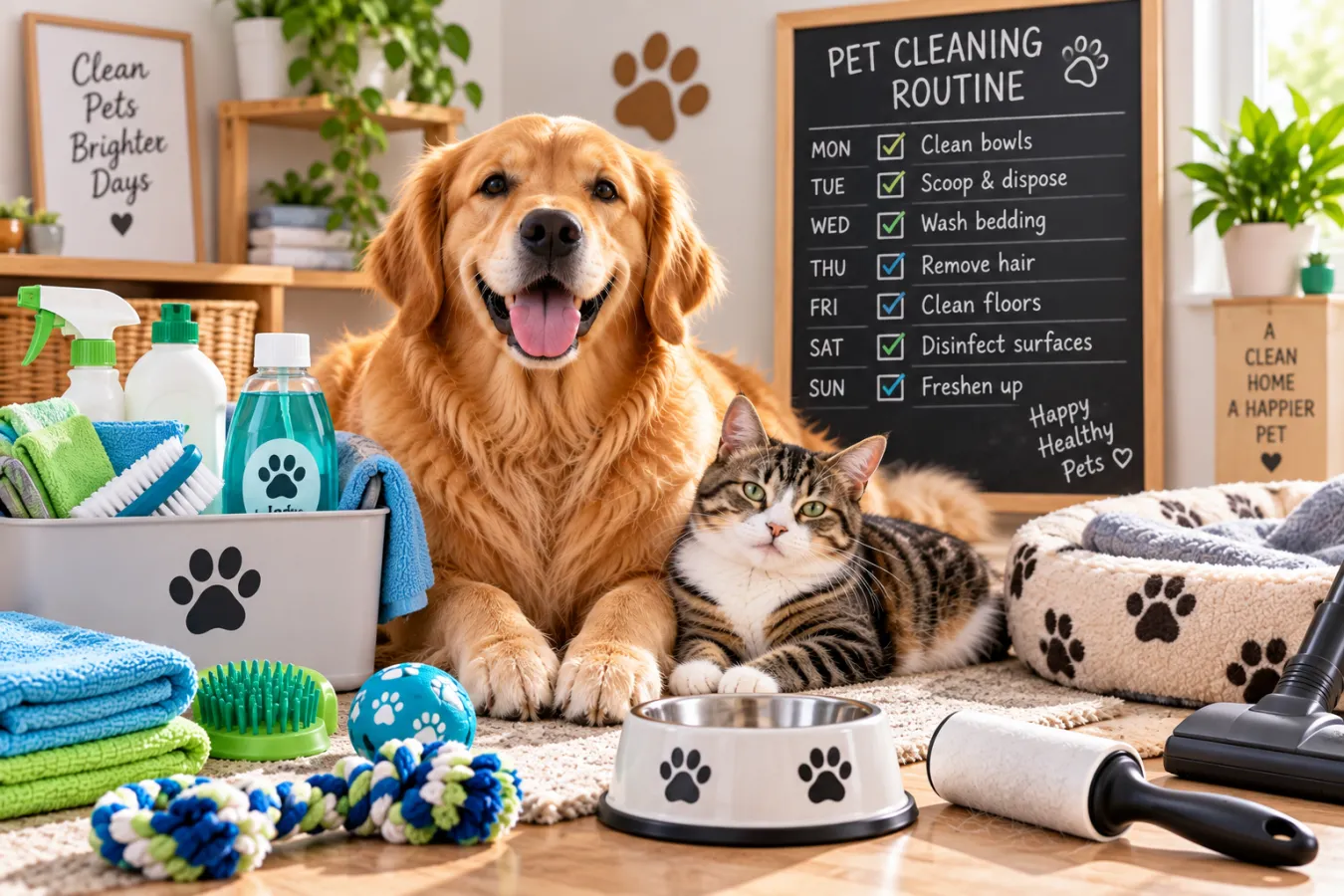
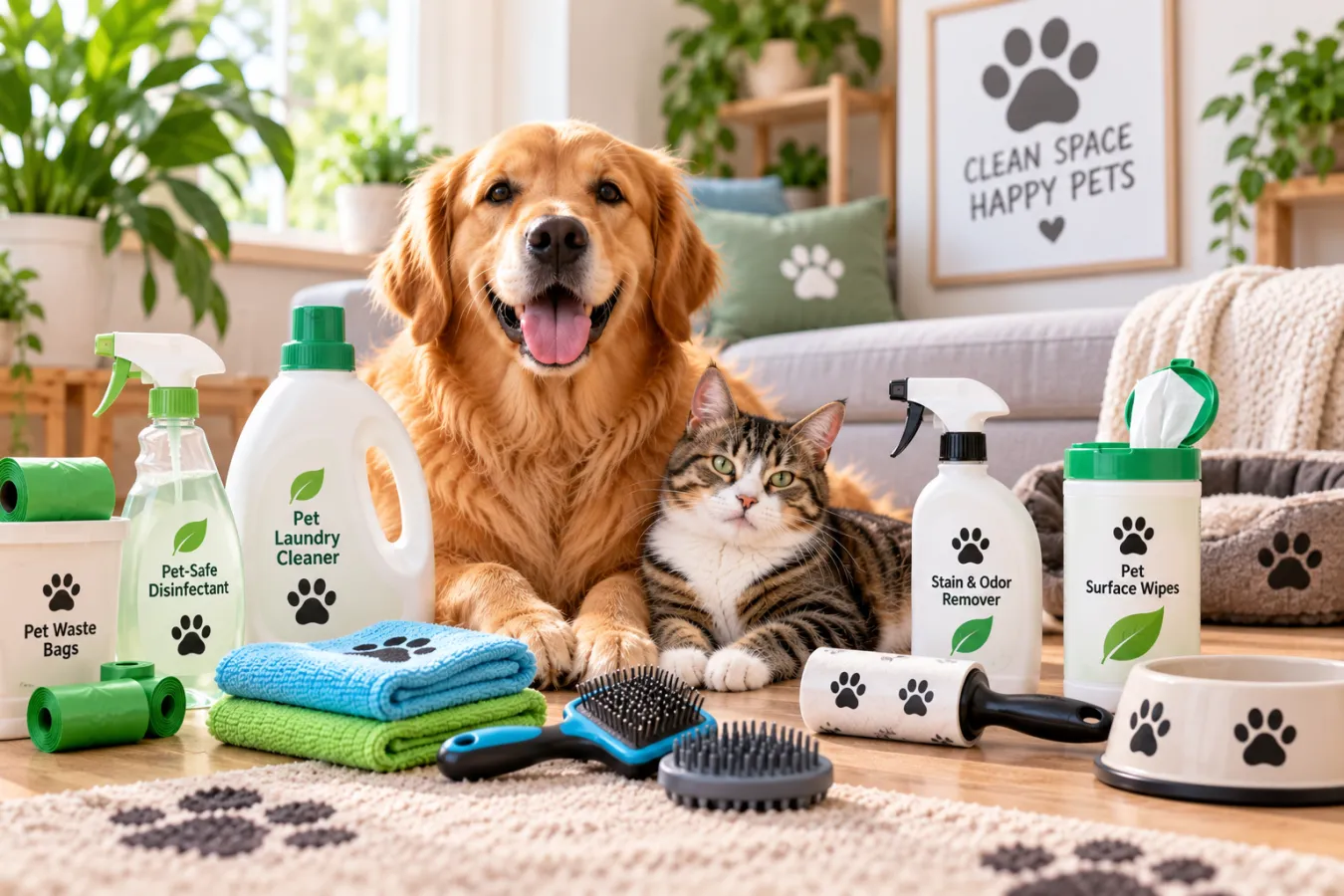
A practical pet-cleaning kit might include:
- Disposable or reusable gloves
- Scrubbing brush
- Suitable sponge
- Clean towels
- Appropriate detergent
- Suitable disinfectant
- Measuring equipment when dilution is required
- Waste bags
- Separate cleaning container
Keeping supplies together makes it easier to maintain a consistent routine.
For pet owners looking at broader hygiene supplies, Best Small Pet Products Every Owner Needs includes cleaning and hygiene products among the practical supplies needed for small-animal care.
20. What to Do if Your Pet Comes Into Contact With Disinfectant
Accidental exposure should be taken seriously.
If your pet:
- Licks wet disinfectant
- Walks through a concentrated product
- Gets disinfectant on its skin or eyes
- Inhales a large amount of irritating fumes
- Chews a disinfectant container
remove the pet from the exposure area and contact a veterinarian promptly.
Keep the product container or label available so the veterinarian can identify the ingredients and concentration.
The ASPCA advises contacting a veterinarian or poison-control service promptly if a pet may have been exposed to a potentially toxic household product.
Don't induce vomiting or attempt home treatment unless a veterinary professional specifically tells you to do so.
Pet-Safe Disinfectant Checklist
Before buying or using a disinfectant, ask:
- Is it intended for the surface I need to clean?
- Is it appropriate for my pet species?
- Does the label provide clear directions?
- Does it require dilution?
- Do I know the correct dilution?
- What is the required contact time?
- Does the surface need to remain wet?
- Does it require rinsing?
- How long should pets stay away?
- Does it require ventilation?
- Does it contain ingredients that may be dangerous to my pet?
- Can it damage the surface?
- How should it be stored?
- What should I do in case of accidental exposure?
If you can't answer these questions, don't guess.
Read the label or contact the manufacturer.
Common Pet Disinfectant Mistakes
Using a Disinfectant Without Reading the Label
Different products have different instructions.
Skipping the Cleaning Step
Dirt and organic material can interfere with some disinfectants.
Ignoring Contact Time
Wiping the product away too quickly may prevent it from working as intended.
Using the Wrong Dilution
Concentrated doesn't automatically mean better.
Mixing Chemicals
This can create dangerous reactions and toxic fumes.
Letting Pets Walk on Wet Surfaces
Wait according to the product's instructions.
Using Disinfectants Directly on Pets
Surface disinfectants are not grooming products.
Storing Products Within Reach
Pets can chew, knock over, or ingest containers.
Assuming "Natural" Means Safe
Always evaluate the actual ingredients and instructions.
A Simple Pet-Safe Disinfection Routine
When disinfection is actually needed, use a straightforward process:
Step 1: Remove Your Pet
Keep your animal away from the area.
Step 2: Remove Food and Water
Take away bowls, treats, toys, and other items that should not be exposed.
Step 3: Remove Visible Dirt
Clean the surface first when appropriate.
Step 4: Prepare the Disinfectant
Follow the exact label instructions for dilution and application.
Step 5: Apply Correctly
Use the application method specified on the label.
Step 6: Follow Contact Time
Keep the surface wet for the required period.
Step 7: Rinse If Required
Some products require rinsing, particularly for certain surfaces.
Step 8: Dry Completely
Allow the surface to dry according to the product instructions.
Step 9: Ventilate
Follow any ventilation requirements.
Step 10: Return Your Pet
Only allow your pet back when the product label indicates that the area is safe.
Frequently Asked Questions
What makes a disinfectant pet-safe?
A disinfectant should be used only according to its label and should be appropriate for the specific pet species, surface, application method, concentration, and exposure conditions. "Pet-safe" should not be treated as a universal label that overrides product instructions.
Can I use household disinfectant around my dog?
Many household cleaning products can be used around dogs when used according to their labeled directions. Keep the dog away during application and while the product is wet when required. Always follow the product label.
Are disinfectants safe around cats?
Some are, when correctly used, but extra care is necessary. The CDC specifically warns against disinfectants containing phenols around cats because phenols are highly toxic to them.
Can I use disinfectant directly on my pet?
No. Household surface disinfectants should not be applied directly to pets. The CDC specifically advises against wiping or bathing pets with disinfectants.
What is contact time in disinfecting?
Contact time is the amount of time a disinfectant must remain on a surface to work effectively. The surface generally needs to remain wet for the required period specified on the product label.
Should I clean before disinfecting?
Usually, yes. Removing dirt and organic material first can help the disinfectant work properly. The CDC recommends cleaning surfaces before disinfecting when appropriate.
Can I mix bleach with another cleaner?
No. Never mix bleach with other cleaning products unless the product instructions explicitly permit a particular combination. Mixing chemicals can create dangerous gases or other hazardous reactions.
How should pet disinfectants be stored?
Keep them in their original labeled containers, tightly closed, and out of reach of pets and children. Store them according to the manufacturer's instructions and away from pet food and water.
Are natural disinfectants automatically safer for pets?
No. "Natural" does not automatically mean safe. Evaluate the ingredients, concentration, intended use, and product instructions before using any cleaning solution around animals.
How long should I keep my pet away after disinfecting?
There is no single waiting time for every product. Follow the disinfectant's label. Some products require pets to stay away until the surface is completely dry.
Final Thoughts
Choosing a pet-safe disinfectant isn't about finding the strongest product on the shelf.
It's about finding the right product for the right surface and using it correctly.
Before buying or using one, check:
Intended use → Pet species → Dilution → Contact time → Application method → Rinsing requirements → Drying → Storage
And remember that routine cleaning is often enough for everyday pet items. Disinfection is an additional step that can be valuable when there is a specific reason to use it.
Keep your pet away from wet disinfectants, never apply surface disinfectants directly to animals, never mix chemicals, and always keep cleaning products securely stored.
A good disinfectant routine isn't complicated.
Read the label. Follow the instructions. Protect your pet.
For more practical pet-care information, explore How to Train Your Cat to Accept Grooming for safe grooming routines and How to Choose the Perfect Cat Bed for guidance on choosing and maintaining comfortable pet products.
Sources & References
- CDC — About Cleaning and Disinfecting Pet Supplies
- U.S. EPA — Read the Label First: Protect Your Pets
- U.S. EPA — Selected EPA-Registered Disinfectants
- U.S. EPA — Biological Contaminants and Indoor Air Quality
- ASPCA — Poisonous Household Products
Disclaimer
This article is intended for general educational purposes and does not replace veterinary advice, product-label instructions, or guidance from the relevant regulatory authority. Always read and follow the disinfectant manufacturer's instructions. If your pet is accidentally exposed to a disinfectant or other cleaning chemical, contact your veterinarian or an appropriate animal poison-control service promptly.
Created with AI • Independently Verified