Algae are a natural part of marine ecosystems, and a small amount of algae in a saltwater aquarium is not necessarily a problem. In fact, certain types of algae can provide food for herbivorous fish and contribute to a functioning aquarium ecosystem. The problem begins when algae grow faster than the aquarium can naturally control them.
Excessive algae growth can cover aquarium glass, rocks, substrate, decorations, and equipment. It can make the aquarium look neglected and may indicate that nutrients, lighting, feeding, or maintenance are out of balance.
The good news is that algae can usually be managed with a consistent routine. Instead of simply removing visible algae, the most effective approach is to identify what is fueling its growth and address the underlying cause.
The most important steps are to monitor nutrients, manage lighting, avoid overfeeding, maintain good water quality, and clean the aquarium regularly.
1. Understand Why Algae Grow
Algae need several things to grow, including light and nutrients. In a saltwater aquarium, excessive algae commonly becomes noticeable when available nutrients exceed what the aquarium's ecosystem can effectively process or export.
Common contributors include:
- Excess food
- Fish waste
- Decaying organic matter
- Overcrowding
- Inadequate filtration
- Poor maintenance
- Excessive lighting
- Nutrient-rich source water
This means algae should not automatically be treated as the primary problem.
Think of algae as a possible symptom of an imbalance.
If you repeatedly clean algae from the glass without addressing the conditions that encourage its growth, it will often return.
2. Monitor Aquarium Nutrients
Nutrient management is one of the most important parts of controlling unwanted algae.
Two nutrients that aquarium keepers commonly monitor are:
- Nitrate
- Phosphate
Both are necessary in marine ecosystems, but excessive levels can contribute to unwanted algae growth.
Testing your aquarium water regularly can help you identify trends before algae becomes overwhelming.
If nutrient levels are consistently elevated, investigate the source rather than immediately adding multiple products designed to remove nutrients.
Potential sources include:
- Overfeeding
- Overstocking
- Uneaten food
- Accumulated waste
- Poorly maintained filter media
- Inadequate water changes
- Poor-quality source water
Finding the source is often more effective than repeatedly treating the symptom.
3. Avoid Overfeeding Your Fish
Overfeeding is one of the easiest ways to unintentionally encourage algae.
Fish only need an appropriate amount of food. Anything they do not eat can eventually break down into organic waste and contribute to nutrient accumulation.
A good feeding routine involves:
- Offering appropriate portions
- Watching how quickly fish eat
- Avoiding unnecessary extra feedings
- Removing persistent uneaten food
- Adjusting portions based on the aquarium's needs
Do not confuse feeding more with providing better care.
A well-fed fish does not need to be surrounded by excess food.
If you consistently notice food settling on the substrate after feeding, consider reducing the amount offered or changing your feeding technique.
4. Manage Your Aquarium Lighting
Light is essential for photosynthetic organisms, including many types of algae. If an aquarium receives more light than necessary, algae may have a greater opportunity to grow.
Consider:
- Daily lighting duration
- Light intensity
- Aquarium placement
- Ambient sunlight
- The type of aquarium you maintain
Avoid placing the aquarium where it receives strong, uncontrolled direct sunlight.
For reef aquariums, lighting must also support corals and other photosynthetic organisms. Therefore, simply reducing the light dramatically may not be appropriate.
Instead, establish a consistent lighting schedule that matches the needs of your livestock.
Keep a Consistent Schedule
Turning aquarium lights on and off randomly can make the system less predictable.
A timer can help maintain consistent lighting periods.
The goal is not to keep the aquarium dark. It is to provide an appropriate amount of light for the organisms you are keeping while avoiding unnecessary exposure.
5. Clean the Aquarium Glass Regularly
Glass algae is one of the easiest forms of algae to control.
A simple aquarium-safe algae scraper or magnetic cleaner can help keep viewing panels clear.
Regular cleaning prevents algae from developing a thick layer that becomes harder to remove.
For best results:
- Inspect the glass regularly.
- Remove visible algae before it becomes heavily established.
- Clean the tool after use as appropriate.
- Avoid scratching acrylic surfaces with unsuitable equipment.
The frequency depends on how quickly algae grows in your aquarium.
Some tanks may require cleaning every few days, while others can go longer.
6. Remove Algae From Rocks and Decorations
Algae can also grow across live rock, artificial rock, decorations, and equipment.
A small amount may be harmless, but thick growth can become unsightly and difficult to manage.
Manual removal can help reduce the amount of algae present in the aquarium.
Depending on the aquarium setup, you can carefully remove algae using an appropriate aquarium-safe brush or scraper.
Avoid aggressively disturbing established rockwork or harming corals and other organisms growing on it.
The objective is controlled removal, not completely sterilizing the aquarium.
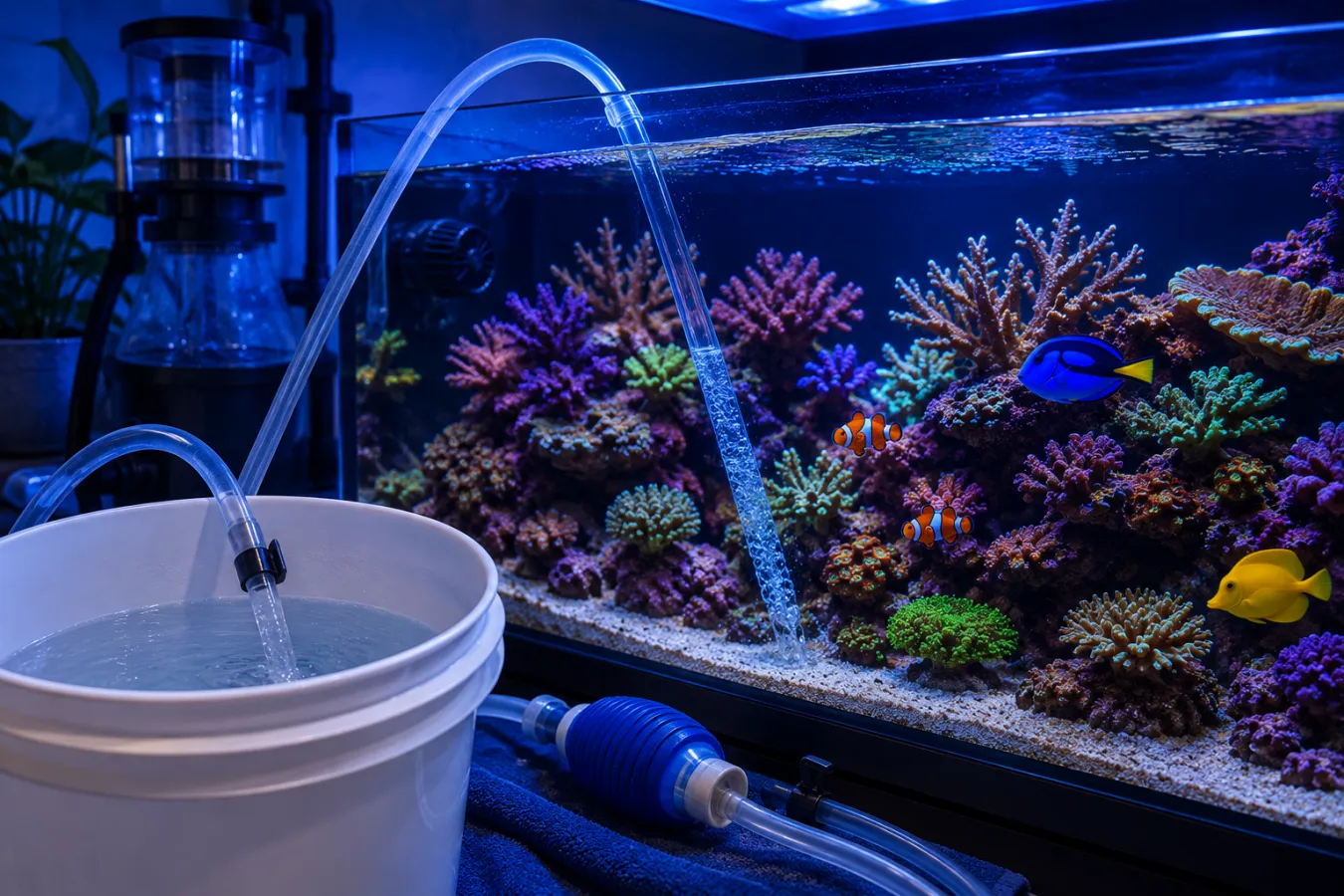
7. Perform Regular Water Changes
Regular water changes are an important part of overall saltwater aquarium maintenance.
A properly prepared water change can help replace a portion of the aquarium water and support good water quality.
Before performing a water change:
- Prepare appropriate replacement water
- Match important parameters as needed
- Check salinity
- Check temperature
- Ensure the new water is properly mixed
Water changes should be part of a broader maintenance strategy rather than the only method used to control algae.
If excessive nutrients continue entering the aquarium through overfeeding or other sources, water changes alone may not solve the problem.
8. Use High-Quality Source Water
The water you add to an aquarium can affect its nutrient balance.
Using untreated or poor-quality source water may introduce substances that contribute to algae growth.
Many marine aquarium hobbyists use purified water, such as appropriately prepared RO/DI water, for mixing saltwater and replacing evaporation.
The quality of source water should be considered if algae growth persists despite good feeding and maintenance practices.
If you suspect your source water is contributing to the problem, test it rather than guessing.
9. Maintain Your Filtration System
Filtration plays an important role in managing waste and nutrients.
Different filtration methods perform different functions, but all aquarium equipment needs appropriate maintenance.
Depending on your setup, this may include:
- Cleaning mechanical filter media
- Replacing disposable filter material when appropriate
- Maintaining protein skimmers
- Cleaning pumps
- Inspecting tubing
- Maintaining biological filtration
Mechanical filter media can collect organic waste. If it is left dirty for too long, accumulated material can break down and contribute to nutrient problems.
Follow the maintenance recommendations for your particular equipment and avoid unnecessarily replacing or disturbing biological filtration.
10. Improve Water Movement
Good water movement is another important part of a healthy marine aquarium.
Circulation helps distribute oxygen and nutrients throughout the system and prevents certain areas from becoming stagnant.
Poor circulation can create areas where:
- Detritus accumulates
- Waste settles
- Debris collects
- Algae establishes more easily
Review the placement and direction of your circulation pumps.
However, more flow is not automatically better. The appropriate level depends on the aquarium's livestock and design.
The objective is to create effective circulation without constantly stressing fish or damaging corals.
11. Remove Detritus Regularly
Detritus consists of accumulated organic debris such as waste, uneaten food, and decomposing material.
If it collects in the aquarium, it can contribute to nutrient accumulation.
Inspect:
- Substrate
- Rockwork
- Filter areas
- Equipment
- Low-flow zones
During routine maintenance, remove accumulated debris carefully.
A gravel vacuum or suitable aquarium siphon can be useful for cleaning appropriate areas of the substrate.
Avoid disturbing the entire aquarium unnecessarily. Focus on areas where debris is visibly accumulating.
12. Consider a Cleanup Crew Carefully
Certain marine invertebrates and herbivorous animals can help consume algae.
Depending on the aquarium, a cleanup crew may include appropriate:
- Snails
- Hermit crabs
- Other algae-eating invertebrates
However, a cleanup crew should not be viewed as a replacement for proper aquarium maintenance.
Adding dozens of animals to an aquarium with an algae problem may create another problem if the aquarium cannot provide enough food for them after the algae decreases.
Choose cleanup-crew species based on:
- Aquarium size
- Existing livestock
- Available food
- Compatibility
- Specific algae type
- Substrate and aquascape
Research the exact species rather than buying a generic "cleanup crew."
13. Identify the Type of Algae
Not all algae should be treated in exactly the same way.
You may encounter:
- Green film algae
- Hair algae
- Turf algae
- Diatoms
- Cyanobacteria-like growth
- Other nuisance organisms
Correct identification can make management much easier.
For example, simply adding an algae-eating animal may not solve a problem caused by cyanobacteria or another organism that is not readily consumed by typical herbivores.
If you are uncertain what you are seeing, take a clear photograph and research the appearance alongside your aquarium's water parameters.
14. Avoid Quick-Fix Algae Treatments
When algae suddenly takes over an aquarium, it can be tempting to purchase a chemical treatment immediately.
However, a quick fix may not address the underlying cause.
Before using an algae-control product, determine:
- Why the algae appeared
- Which organism is growing
- Whether nutrients are elevated
- Whether lighting is excessive
- Whether maintenance has changed
- Whether the aquarium is overfed or overstocked
Some treatments can also affect organisms other than the target algae.
Follow product instructions carefully and understand potential effects on fish, corals, invertebrates, biological filtration, and water chemistry.
Common Algae-Control Mistakes
Scrubbing Without Finding the Cause
Removing visible algae is useful, but it does not solve the conditions that caused it.
Overfeeding
Excess food creates additional waste and can contribute to nutrient accumulation.
Leaving Lights on Too Long
Excessive lighting can encourage algae growth, especially when nutrients are also available.
Adding Too Many Cleanup-Crew Animals
A large cleanup crew cannot compensate for poor aquarium management and may eventually run out of food.
Ignoring Water Testing
Testing can help identify nutrient problems that are not visible to the eye.
Making Too Many Changes at Once
Changing lighting, filtration, feeding, livestock, and water chemistry simultaneously can make it difficult to determine what actually solved the problem.
Make changes carefully and observe the results.
A Simple Algae-Control Routine
A consistent maintenance schedule can prevent many algae problems from becoming severe.
Daily
Check:
- Fish behavior
- Feeding
- Water level
- Lighting schedule
- Obvious algae growth
Several Times Per Week
Monitor:
- Aquarium glass
- Uneaten food
- Detritus accumulation
- General water quality
Regularly
Perform:
- Water testing
- Water changes
- Filter maintenance
- Equipment cleaning
- Manual algae removal
The exact frequency should depend on your aquarium's size, livestock, filtration, feeding habits, and nutrient levels.
When Algae Is Actually Helpful
It is important to remember that algae itself is not always the enemy.
Some algae can provide:
- Food for herbivorous fish
- Habitat for microorganisms
- Nutrient uptake
- Natural-looking growth on rockwork
- Part of a functioning marine ecosystem
The goal of algae management is therefore not necessarily to achieve an aquarium with absolutely no algae.
Instead, aim for controlled growth that does not overwhelm the aquarium or interfere with your livestock.
Final Thoughts
Controlling algae in a saltwater aquarium is usually more effective when you address the cause rather than constantly removing the visible growth.
Monitor nutrients, control feeding, manage lighting, maintain filtration, remove accumulated waste, perform regular water changes, and manually clean algae when necessary.
If algae continues to return, investigate the aquarium's nutrient sources and environmental conditions rather than relying solely on algae-eating animals or chemical treatments.
The most effective approach can be summarized simply:
Control nutrients, manage lighting, avoid overfeeding, maintain good water quality, and stay consistent with aquarium maintenance.
With patience and a balanced maintenance routine, most algae problems can become much easier to manage, leaving you with a cleaner, healthier, and more attractive saltwater aquarium.