Building a healthy saltwater aquarium is exciting, but long-term success depends on much more than choosing beautiful fish and setting up an attractive aquascape. A marine aquarium is a carefully balanced environment where water chemistry, livestock, filtration, equipment, feeding, and maintenance all influence one another. Small problems can become much harder to manage when they are ignored, especially in a newly established aquarium.
The good news is that maintaining a stable saltwater aquarium doesn't have to be complicated. The key is to build the system carefully from the beginning and develop consistent habits. Appropriate stocking, regular water testing, effective filtration, routine maintenance, and careful observation can help you create an aquarium that is easier to manage and more comfortable for its inhabitants.
What Makes a Saltwater Aquarium Healthy and Stable?
A healthy saltwater aquarium is one where environmental conditions remain appropriate and relatively stable for the fish, corals, and invertebrates being kept. Stability doesn't mean that every measurement stays exactly the same every minute. Instead, it means avoiding unnecessary or sudden changes and maintaining conditions appropriate for your livestock.
Several factors work together to create this stability:
- Appropriate stocking
- Stable salinity
- Suitable temperature
- Effective filtration
- Adequate water movement
- Regular water testing
- Responsible feeding
- Routine maintenance
- Careful observation
If you're building an aquarium from scratch, filtration should be one of your early considerations. Understanding how to choose the right aquarium filter can help you select equipment according to your aquarium's size and livestock.
1. Start With a Realistic Aquarium Plan
Before purchasing equipment or livestock, decide what kind of saltwater aquarium you want.
Are you planning a:
- Fish-only aquarium?
- Fish-only system with live rock?
- Soft-coral reef?
- Mixed reef?
- SPS-focused reef?
Your answer will influence almost every other decision you make.
A fish-only aquarium can have different requirements from a reef aquarium containing corals and invertebrates. Your equipment, lighting, filtration, water movement, and maintenance routine should therefore be selected around your long-term goals.
This same planning approach applies when choosing freshwater livestock. Before adding fish to a community aquarium, understanding how to choose compatible freshwater fish can help you make decisions based on compatibility rather than appearance alone.
2. Establish Biological Filtration First
One of the most important steps in setting up a new saltwater aquarium is allowing its biological filtration system to establish.
Beneficial microorganisms help process waste produced by aquarium inhabitants. A new aquarium needs time for these biological communities to develop before it can safely support a full population of fish.
This is why rushing to add livestock can create problems.
During the initial setup period, monitor the aquarium and follow an appropriate cycling process. Don't assume that clear water means the aquarium is ready for fish.
Testing provides information that your eyes cannot. Learning how to test aquarium water can help you understand the importance of monitoring water conditions throughout the life of your aquarium.
3. Choose Appropriate Stocking Levels
Appropriate stocking is one of the foundations of a stable saltwater aquarium.
Every fish adds biological demand to the system. Fish consume food, produce waste, require oxygen, and occupy physical space. Adding too many animals can therefore place additional pressure on filtration and maintenance.
Before buying a fish, research its:
- Adult size
- Temperament
- Diet
- Swimming behavior
- Space requirements
- Compatibility
- Reef compatibility
- Expected care requirements
Don't choose livestock simply because it looks attractive at the store.
A carefully selected group of compatible animals is usually easier to maintain than an overcrowded aquarium.
The same principle applies to freshwater systems. How to choose compatible freshwater fish explains why compatibility should be considered before adding species to an aquarium.
4. Add Fish Gradually
Once your aquarium is established, avoid adding a large number of fish at once.
Adding livestock gradually gives your biological filtration time to adjust to additional waste production. It also gives you an opportunity to observe each new fish and make sure it is behaving normally.
A gradual approach can also make compatibility problems easier to identify. If you introduce several species simultaneously, it can become difficult to determine which animal is causing aggression or stress.
Patience is especially important for beginners. A saltwater aquarium is a long-term project, and there is no need to fill it immediately.
5. Maintain Stable Salinity
Salinity is one of the most important water parameters in a saltwater aquarium.
Marine fish, corals, and invertebrates are adapted to saltwater conditions, so sudden changes can create unnecessary stress.
Use a reliable salinity-measuring device and establish an appropriate target for your particular aquarium.
Also remember that evaporation affects salinity. Water evaporates while dissolved salt remains behind, which can gradually increase salinity if evaporation isn't managed correctly.
Regular testing helps you identify changes before they become significant problems. A consistent water-testing routine is therefore an important part of long-term aquarium stability.
6. Keep Temperature Consistent
Temperature is another important part of a healthy marine aquarium.
Rather than focusing only on a specific number, pay attention to stability and the needs of your livestock. Sudden temperature changes can place unnecessary stress on aquarium inhabitants.
Use a reliable thermometer and make sure your heating equipment is appropriate for your aquarium.
Equipment placement matters too. Avoid installing equipment where saltwater can easily splash onto electrical connections.
For general aquarium-heating principles, you can also read how to choose the right freshwater aquarium heater.
7. Use Effective Filtration
Filtration is one of the most important pieces of equipment in a saltwater aquarium.
Depending on the system, filtration can include mechanical, biological, and chemical components. Reef aquariums may also use equipment such as protein skimmers and specialized filtration systems.
Your filtration should be appropriate for:
- Aquarium size
- Number of fish
- Feeding level
- Livestock type
- Waste production
- Maintenance routine
However, even excellent filtration cannot completely compensate for severe overstocking or excessive feeding.
Think of filtration as one component of a larger system.
If you're comparing equipment, how to choose the right aquarium filter can help you understand what to consider before making a purchase.
8. Provide Appropriate Water Movement
Water movement helps distribute oxygen, heat, and nutrients throughout the aquarium. It can also help keep waste suspended so that filtration equipment can capture or process it.
In reef aquariums, water movement is especially important because different corals can have different flow preferences.
However, more flow isn't automatically better.
Observe your livestock and adjust circulation according to their needs. Try to avoid creating areas of extremely strong flow that constantly disturb sand or stress delicate organisms.
Good water movement should work together with your aquascape and filtration rather than being treated as an independent feature.
9. Feed Your Livestock Responsibly
Feeding is one of the simplest ways to influence aquarium water quality.
Fish need appropriate nutrition, but excessive feeding can introduce more organic material into the aquarium than your system can comfortably process.
A good feeding routine involves:
- Providing appropriate portions
- Choosing suitable food
- Observing feeding behavior
- Avoiding unnecessary overfeeding
- Removing appropriate uneaten food when necessary
10. Test Your Water Consistently
One of the biggest mistakes beginners make is assuming that clear water means healthy water.
Unfortunately, many important changes in aquarium chemistry cannot be seen with the naked eye.
Depending on your setup, you may monitor:
- Salinity
- Temperature
- pH
- Ammonia
- Nitrite
- Nitrate
- Phosphate
- Alkalinity
- Calcium
- Magnesium
The exact parameters and testing frequency should depend on your aquarium and livestock.
For example, a fish-only aquarium may have different testing priorities from a reef aquarium containing corals.
Regular testing helps you identify trends and make informed decisions rather than relying on guesswork.
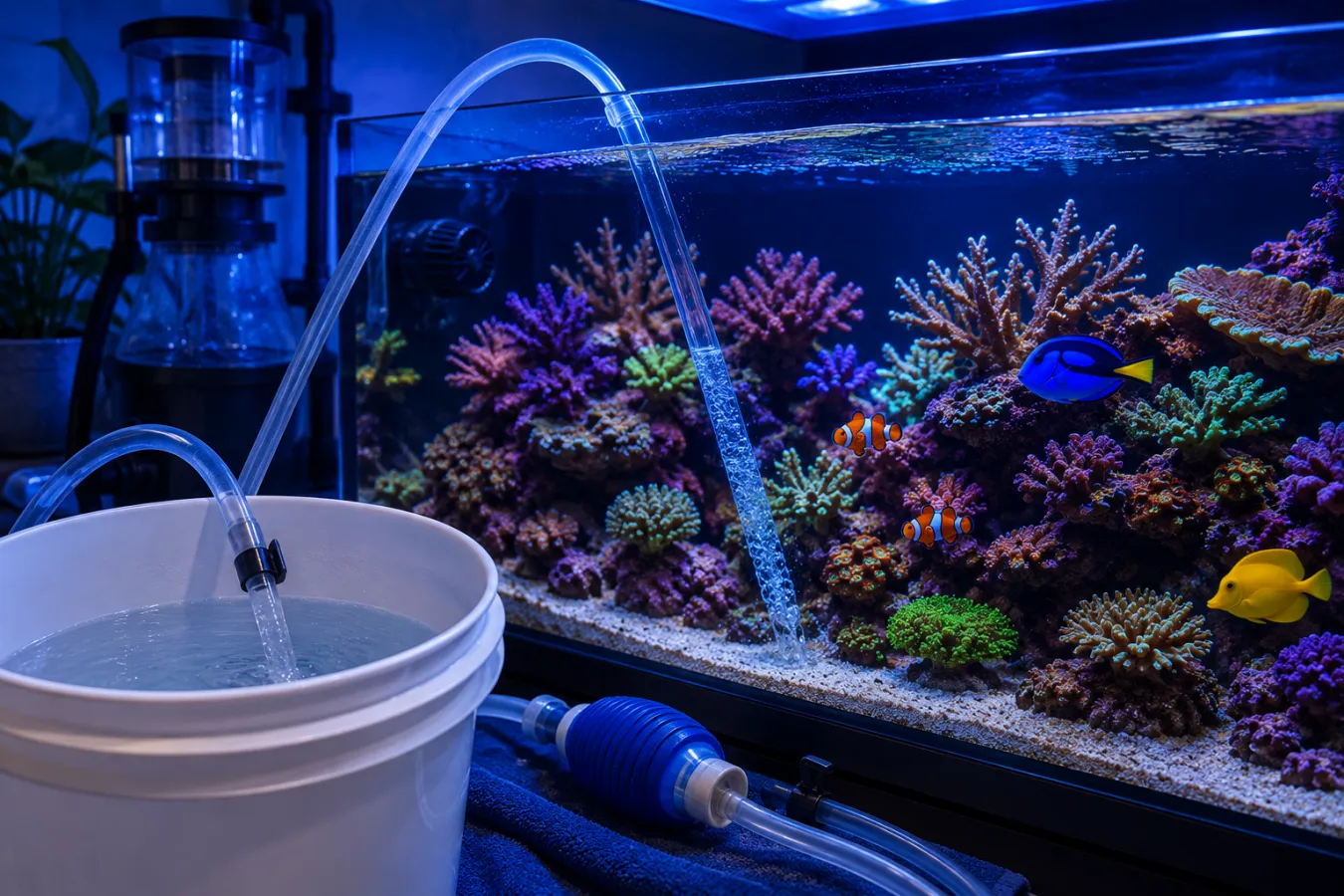
11. Perform Regular Water Changes
Water changes can help manage unwanted compounds and replenish components present in freshly prepared saltwater.
The appropriate amount and frequency depend on your aquarium, livestock, filtration, feeding, nutrient levels, and testing results.
When preparing replacement water:
- Use appropriate source water.
- Mix the marine salt according to the manufacturer's instructions.
- Check salinity.
- Match the temperature appropriately.
- Add the replacement water carefully.
Avoid treating water changes as a last-minute solution to every aquarium problem. They should be part of a broader maintenance strategy.
For more detailed guidance, read how to perform a safe aquarium water change.
12. Understand Evaporation and Top-Offs
Evaporation is normal in marine aquariums, especially in systems with strong surface movement, lighting, and ventilation.
However, evaporation removes water rather than salt. As water evaporates, salinity can gradually increase.
This means topping off an aquarium is different from performing a water change.
A top-off replaces evaporated water, while a water change removes existing aquarium water and replaces it with properly prepared saltwater.
Keeping this distinction clear can help prevent gradual salinity problems.
13. Observe Your Fish and Corals Every Day
Water testing tells you what's happening chemically, but observation tells you what's happening biologically.
Spend a few minutes each day looking at your aquarium.
Watch for:
- Changes in swimming behavior
- Reduced appetite
- Unusual hiding
- Aggression
- Rapid breathing
- Changes in coral appearance
- Unusual spots or marks
- Equipment problems
Don't ignore small changes.
A fish that behaves differently today may be showing an early sign of stress. Early observation gives you more time to investigate.
This is one reason aquarium maintenance should involve more than simply cleaning the glass and changing water.
14. Quarantine New Fish When Appropriate
Introducing a new fish can introduce unwanted diseases or parasites into an established aquarium.
For many marine aquarists, a separate quarantine system is an important part of livestock management.
Quarantine gives you an opportunity to observe new fish before introducing them to your display aquarium.
The exact quarantine approach depends on the species, situation, and aquarist's disease-management practices.
The broader principle is simple:
Don't rush new livestock into your established aquarium.
15. Avoid Making Too Many Changes at Once
Marine aquariums can be sensitive to sudden changes.
If you suddenly change lighting, add several fish, alter feeding, change filtration, and perform a large water change at the same time, it becomes difficult to determine how the aquarium will respond.
Instead, make significant changes gradually whenever possible.
This also gives you an opportunity to observe the effect of each change.
A stable aquarium isn't one where nothing ever changes. It's one where changes are planned, measured, and controlled.
Common Saltwater Aquarium Mistakes
Adding Fish Too Quickly
Why it's a problem: A new aquarium may not yet have sufficient biological capacity to handle increased waste production.
Better approach: Establish the aquarium properly and add livestock gradually.
Ignoring Salinity
Why it's a problem: Changes in salinity can stress marine organisms.
Better approach: Measure salinity regularly and manage evaporation appropriately.
Overstocking
Why it's a problem: Excessive livestock increases biological demand and can make water quality and maintenance more difficult.
Better approach: Research adult size, behavior, compatibility, and space requirements.
Skipping Water Testing
Why it's a problem: Many changes in water chemistry aren't visible.
Better approach: Establish a regular testing routine.
Overfeeding
Why it's a problem: Uneaten food can contribute to unwanted organic material and nutrients.
Better approach: Feed appropriate portions and observe how much your livestock actually consumes.
Neglecting Equipment
Why it's a problem: A failed heater, pump, filter, or other critical component can quickly affect aquarium stability.
Better approach: Inspect equipment regularly and replace aging or damaged components when appropriate.
Create a Simple Maintenance Routine
A routine makes aquarium care easier and more predictable.
Daily
Check:
- Fish behavior
- Coral appearance
- Temperature
- Water level
- Equipment operation
Weekly
Consider:
- Water testing
- Glass cleaning
- Equipment inspection
- Maintenance tasks
- Water changes according to your established routine
Monthly
Review:
- Filter components
- Pumps
- Heater
- Lighting
- Tubing
- Livestock condition
- Maintenance records
Your schedule may vary depending on your aquarium.
The most important thing is consistency.
A Healthy Saltwater Aquarium Checklist
Before adding a new fish or making a major change, ask yourself:
Is my aquarium biologically established?
Is my salinity stable?
Is my temperature stable?
Is my filtration appropriate?
Is the new livestock compatible?
Do I have enough space for the animal when fully grown?
Am I already appropriately stocked?
Am I testing my water regularly?
Can my maintenance routine handle the additional livestock?
Have I considered quarantine?
If the answer to these questions is yes, you're giving yourself a much stronger foundation for long-term aquarium success.
Final Thoughts
Building a healthy and stable saltwater aquarium isn't about creating a perfect system overnight. It's about making good decisions consistently.
Start with a realistic plan, establish biological filtration, and choose livestock carefully. Avoid adding fish too quickly and don't overstock the aquarium. Keep salinity and temperature stable, provide effective filtration and appropriate water movement, feed responsibly, and make regular water testing part of your routine.
Remember that your aquarium is an interconnected ecosystem. Filtration, feeding, stocking, water chemistry, temperature, and maintenance all influence one another.
Most importantly, be patient. Marine aquariums reward careful planning far more than rushing. Adding one fish at a time, monitoring your water, observing your livestock, and making gradual changes can help you identify problems early and maintain greater stability.
A healthy saltwater aquarium doesn't happen because of one piece of equipment or one maintenance task. It comes from hundreds of small, consistent decisions made over time. With appropriate stocking, reliable filtration, regular testing, and attentive maintenance, you can build a marine aquarium that is not only beautiful but also stable and easier to manage for years to come.