A little algae in an aquarium is completely normal. In fact, algae are a natural part of aquatic ecosystems. The problem begins when algae grow faster than your aquarium can naturally manage them. Thick green growth on the glass, decorations, substrate, and plants can make a beautiful aquarium look neglected, while excessive algae may also point to an imbalance in lighting, nutrients, feeding, or maintenance.
The good news is that you do not need to rely on strong chemicals or constant scrubbing to control algae. In many cases, natural algae management comes down to creating a better balance between light, nutrients, plants, filtration, and routine care.
The goal is not necessarily to remove every trace of algae. Instead, the goal is to prevent excessive growth and maintain an aquarium that is healthy, attractive, and stable.
Here are practical ways to control algae naturally.
1. Understand Why Algae Grow
Before trying to remove algae, it helps to understand why they are growing in the first place.
Algae need three basic things to thrive:
Light
Nutrients
Water
You cannot remove water from an aquarium, and you should not try to eliminate all nutrients. Instead, algae control focuses on keeping light and nutrient availability at appropriate levels.
If an aquarium receives excessive light while nutrients are also abundant, algae may multiply rapidly.
Common causes of excessive algae include:
- Aquarium lights being left on too long
- Direct sunlight entering the aquarium
- Overfeeding
- Excess fish waste
- Infrequent water changes
- Poor filtration
- Decaying plant material
- Overstocking
Instead of treating algae as the problem itself, think of algae growth as a useful signal that something in the aquarium may need adjustment.
2. Control Your Aquarium Lighting
Managing light is one of the simplest ways to reduce algae naturally.
Aquarium plants need light for photosynthesis, but algae also benefit from the same light. Leaving your aquarium lights on for excessive periods can give algae more opportunity to grow.
A consistent lighting schedule is better than leaving lights on whenever the aquarium is visible.
For many home aquariums, keeping the lighting period controlled and consistent can help prevent excessive algae growth. The ideal duration depends on the aquarium, plant species, light intensity, and setup.
Consider using a timer so the lights turn on and off at the same time each day.
This helps prevent accidental over-lighting and creates a more predictable environment for plants and fish.
Also pay attention to natural sunlight.
If your aquarium receives strong direct sunlight for several hours every day, algae can become much harder to control. Consider positioning the aquarium away from intense direct sunlight or reducing the amount of light reaching the tank.
3. Avoid Overfeeding Your Fish
Overfeeding is one of the most common reasons algae become difficult to manage.
Fish need food, but uneaten food eventually breaks down and adds nutrients to the aquarium. Fish waste also contributes nutrients.
Those nutrients can support algae growth.
A simple rule is to feed an appropriate amount based on the species, size, age, and dietary requirements of your fish.
Watch what happens after feeding.
If food regularly remains on the bottom or floats around the aquarium for long periods, you may be feeding more than the fish can consume.
To reduce excess nutrients:
- Offer controlled portions
- Remove uneaten food
- Avoid unnecessary extra feedings
- Adjust feeding amounts as your fish population changes
Better feeding habits do more than control algae. They also help maintain overall water quality.
4. Perform Regular Water Changes
Regular partial water changes are an important part of natural algae management.
Water changes help dilute accumulated nutrients and remove some of the dissolved waste that can contribute to algae growth.
The exact water-change schedule depends on the aquarium, but many home aquariums benefit from regular partial changes rather than occasional major cleanings.
During a water change, you can also remove debris from the substrate using an aquarium siphon or gravel vacuum.
This helps reduce the amount of decomposing organic material available to fuel excessive algae growth.
Avoid assuming that a huge water change is always better. Large, sudden changes can create unnecessary instability.
Consistent, appropriate maintenance is usually more effective.
5. Keep the Aquarium Free From Excess Waste
Algae can take advantage of nutrients released by decaying organic material.
Check your aquarium regularly for:
- Uneaten food
- Excess fish waste
- Dead leaves
- Dead organisms
- Decaying plant material
- Debris trapped in the substrate
Remove visible waste when appropriate.
Regular maintenance helps prevent these materials from breaking down and contributing additional nutrients to the water.
A gravel vacuum can be especially useful because waste can accumulate underneath and between substrate particles where it is difficult to see.
You do not need to remove every microorganism or completely sterilize the aquarium. The objective is simply to prevent excessive waste from building up.
6. Add Healthy Live Plants
Live aquatic plants can be useful allies in natural algae management.
Plants and algae compete for nutrients and light. Healthy, actively growing plants can absorb nutrients from the water and help reduce the resources available to algae.
Plants can also provide a more balanced and natural appearance.
However, simply adding a few plants does not guarantee that algae will disappear.
Plants need suitable:
- Lighting
- Nutrients
- Water conditions
- Substrate
- Carbon availability, depending on the species and setup
Choose plants that match your aquarium's conditions.
Fast-growing aquatic plants can be particularly useful in nutrient management because they can consume nutrients quickly when conditions support healthy growth.
7. Avoid Excessive Fertilizer
If you have a planted aquarium, fertilizers can support healthy plant growth, but more fertilizer is not automatically better.
Excess nutrients can become available to algae when plants are unable to use them efficiently.
Follow the fertilizer manufacturer's instructions and adjust your routine based on the needs of your plants and aquarium.
Avoid adding nutrients simply because you believe more will make plants grow faster.
The goal is balance.
Healthy plants, controlled lighting, appropriate feeding, and good maintenance should work together rather than relying on one single solution.
8. Improve Water Movement and Filtration
Filtration helps remove particles and supports the aquarium's biological system.
Poor filtration can allow organic waste and debris to accumulate, potentially contributing to nutrient buildup and algae problems.
Check regularly that your filter is functioning correctly.
Look for:
- Reduced water flow
- Blocked intake
- Dirty mechanical media
- Obstructed tubing
- Unusual noises
- Poor circulation
Good water movement also helps distribute oxygen and nutrients throughout the aquarium.
However, stronger flow is not automatically better. Some fish and plants prefer gentle water movement.
The aim is to provide circulation appropriate for the species and aquarium design.
9. Clean Aquarium Glass Regularly
Even when algae growth is well controlled, some algae may naturally appear on the aquarium glass.
This does not mean the whole aquarium is unhealthy.
Regularly cleaning the glass can keep the aquarium looking attractive.
A suitable algae scraper, magnetic cleaner, or aquarium-safe cleaning pad can make this task simple.
Clean only as often as necessary. Some aquariums may need glass cleaning every few days, while others may remain clear for much longer.
Never use household glass cleaners or chemical sprays around aquarium water.
Even small amounts of inappropriate chemicals can be harmful to fish and other aquatic organisms.
10. Remove Algae From Decorations and Equipment
Algae can also grow on rocks, ornaments, filter pipes, heaters, and other surfaces.
If algae become excessive, gently clean affected surfaces using aquarium-safe methods.
Do not use soap or household cleaning products.
For removable decorations, you can take them out of the aquarium and clean them appropriately before returning them.
However, do not feel that every tiny patch of algae needs to be eliminated.
A small amount of algae is a normal part of many aquarium environments.
The goal is to control excessive growth, not create a completely sterile display.
11. Consider Natural Algae-Eating Livestock Carefully
Some aquatic animals naturally consume certain types of algae and can become part of an algae-management strategy.
Depending on your aquarium, suitable species may include certain algae-eating snails, shrimp, or fish.
However, livestock should never be purchased simply as a cleaning tool.
Every animal has specific requirements for:
- Tank size
- Water parameters
- Food
- Temperature
- Compatibility
- Mature aquarium conditions
- Long-term care
An algae eater still produces waste. Adding more animals to an already overcrowded aquarium can actually create additional water-quality problems.
Choose algae-eating species because they are appropriate for your aquarium, not because you expect them to do all the cleaning.
12. Do Not Depend on Chemical Algae Treatments
Chemical algae treatments may appear to offer a quick solution, but they do not necessarily address why algae are growing.
If excessive lighting, overfeeding, or nutrient buildup continues, the algae may return after the treatment ends.
Some treatments can also affect aquatic plants, microorganisms, or sensitive livestock depending on the product and dosage.
Natural algae control generally focuses on correcting the environmental conditions that encourage excessive growth.
Start with:
- Lighting control
- Feeding control
- Water changes
- Waste removal
- Filtration
- Healthy plant growth
These strategies support the aquarium's overall health instead of simply treating the visible algae.
13. Avoid Direct Sunlight
One of the easiest algae problems to prevent is excessive exposure to natural sunlight.
If your aquarium sits near a bright window, direct sunlight can dramatically increase algae growth.
Sunlight can also contribute to temperature fluctuations, especially during warmer months.
Consider placing the aquarium in an area with stable ambient light rather than strong direct sunlight.
If moving the aquarium is not practical, reducing direct exposure with suitable curtains or blinds can help.
Remember that the aquarium's artificial lighting should be considered along with sunlight. Even a moderate artificial lighting schedule may become excessive when strong sunlight is reaching the tank for several hours each day.
14. Keep Your Fish Population Appropriate
Overstocking can make algae control much more difficult.
More fish means more:
- Waste
- Feeding
- Nutrients
- Oxygen demand
- Filtration requirements
An aquarium with an excessive number of fish may experience rising nutrient levels even when the owner is performing regular maintenance.
Before adding new fish, consider the adult size of the species, aquarium volume, filtration capacity, and compatibility.
A properly stocked aquarium is generally easier to maintain than one that is pushed beyond its biological capacity.
15. Identify the Type of Algae You Have
Not all algae behave the same way.
You may encounter:
Green spot algae: Hard green spots that commonly appear on glass and other surfaces.
Green hair algae: Long, thread-like green growth.
Brown algae or diatoms: Brownish coatings that are particularly common in newer aquariums.
Green water: Free-floating algae that makes the entire aquarium appear green and cloudy.
Blue-green growth: Sometimes associated with cyanobacteria rather than true algae.
Identifying the type of growth can help you determine the most appropriate management strategy.
For example, green water requires a different approach from algae growing directly on aquarium glass.
16. Be Patient With Natural Algae Control
One of the biggest mistakes aquarium owners make is expecting algae to disappear overnight.
If excessive algae has developed because of months of nutrient buildup and excessive light, correcting the problem may take time.
Natural algae management works by changing the conditions that support growth.
You may need to:
- Reduce lighting
- Adjust feeding
- Increase maintenance consistency
- Remove accumulated waste
- Improve filtration
- Add or improve plant growth
- Reduce stocking pressure
Give the aquarium time to respond.
Trying several drastic changes at once can make it difficult to determine what worked and may create unnecessary instability.
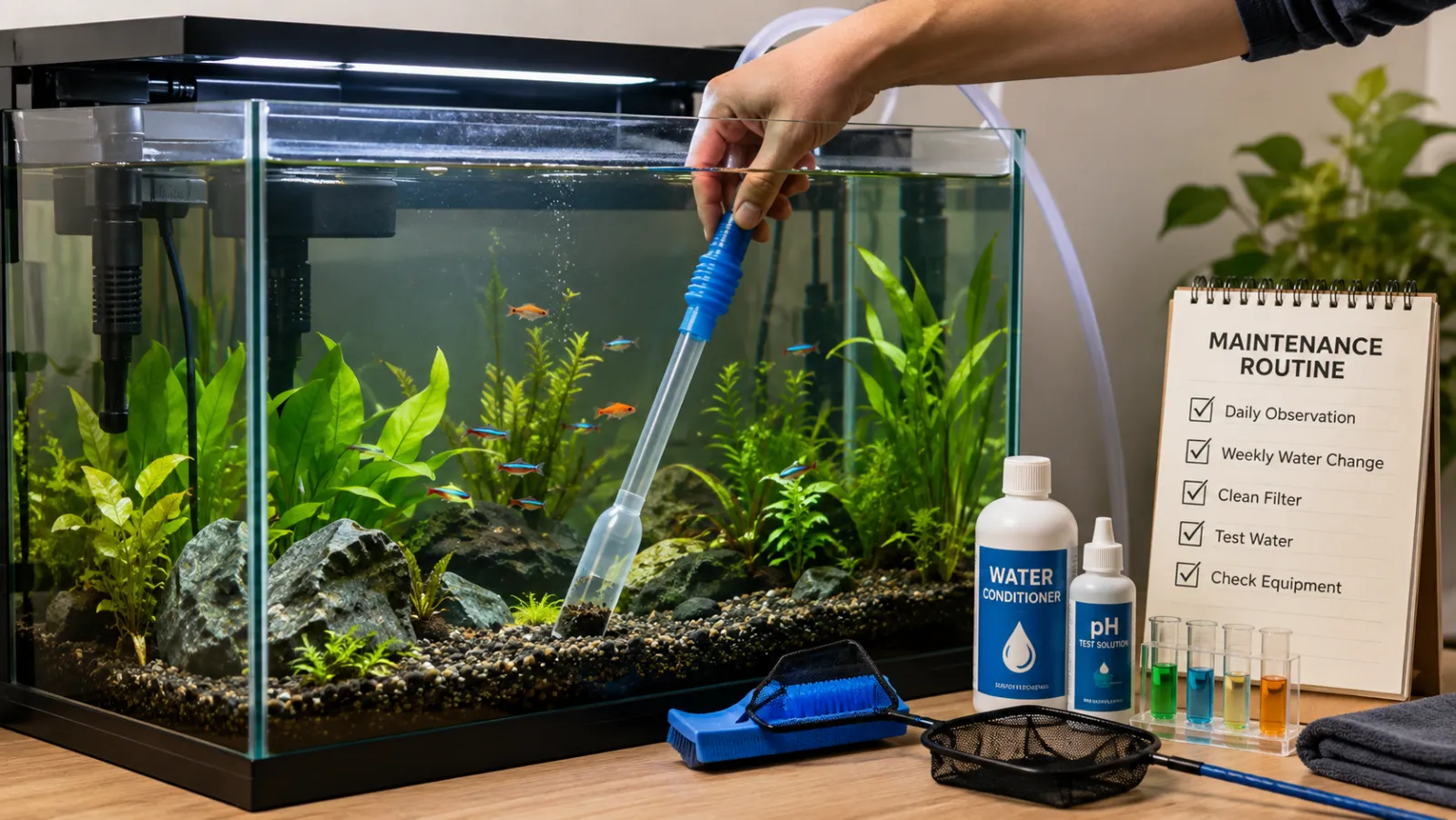
17. Create a Simple Algae-Control Routine
A regular routine can make algae much easier to manage.
Daily:
Observe fish, check equipment, and make sure feeding is controlled.
Weekly:
Inspect algae growth, remove visible waste, test water as appropriate, and perform an appropriate partial water change.
As needed:
Clean aquarium glass, remove excessive algae from decorations, trim plants, and inspect filtration.
Monthly:
Review lighting duration, stocking levels, feeding habits, and overall water quality.
This approach prevents small algae problems from becoming large ones.
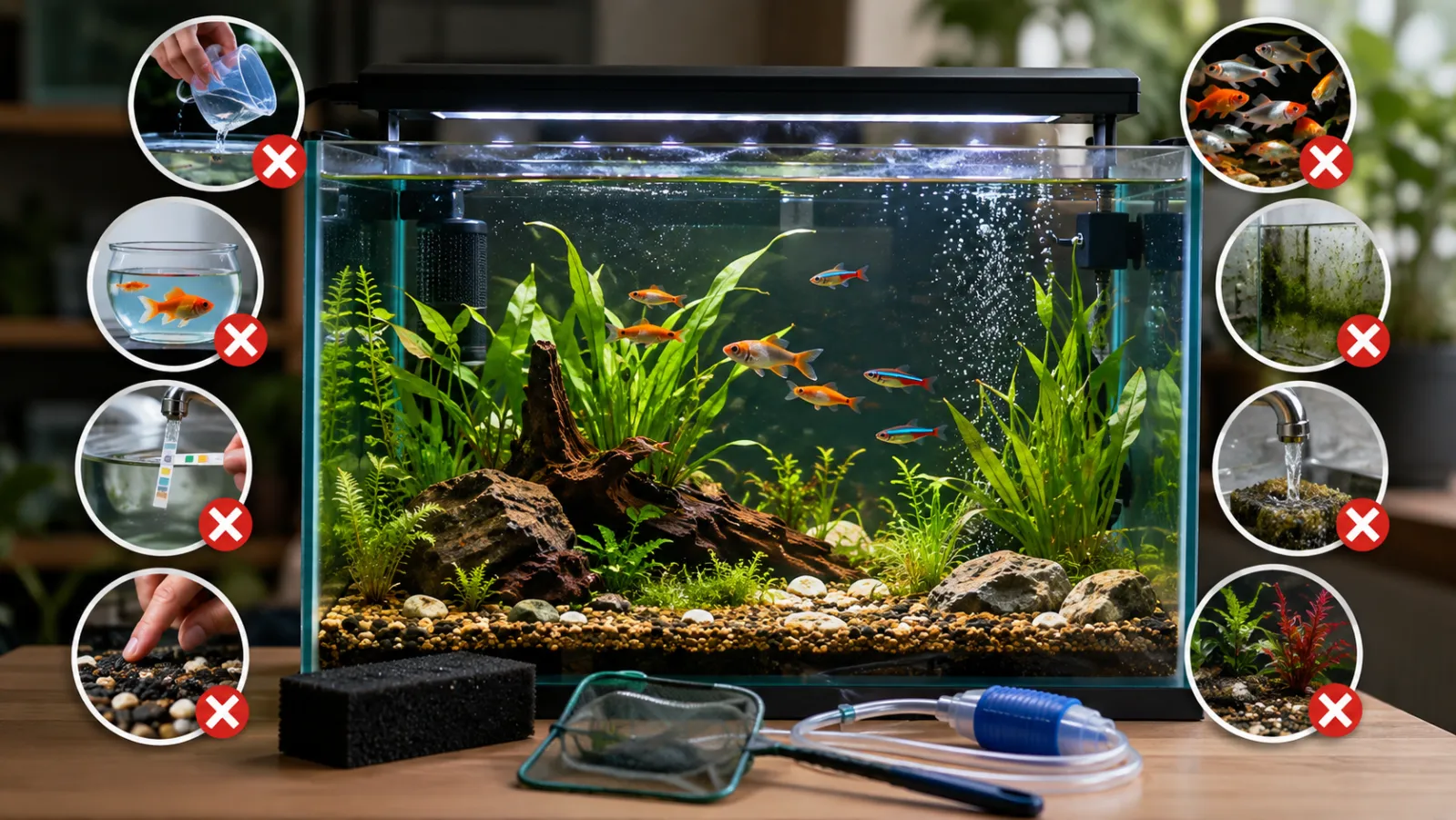
Common Algae-Control Mistakes to Avoid
Leaving aquarium lights on all day: Excessive lighting can encourage algae growth.
Overfeeding: Uneaten food adds nutrients to the aquarium.
Ignoring water changes: Nutrients can accumulate over time.
Adding too many algae eaters: More livestock also creates more waste.
Using chemicals as the first solution: Treatments may not address the underlying imbalance.
Removing all algae: A small amount of algae is normal in many aquariums.
Ignoring direct sunlight: Natural light can contribute significantly to algae growth.
Over-cleaning: Excessive cleaning can disturb the aquarium's biological balance.
The best results usually come from correcting the conditions that encourage algae rather than repeatedly removing the algae itself.
Final Thoughts
Learning how to control algae naturally is an important part of aquarium care. Algae are not automatically a sign that an aquarium is unhealthy. In reasonable amounts, they are a normal part of an aquatic ecosystem.
The problem occurs when algae grow excessively and begin covering surfaces, competing with plants, affecting appearance, or signaling that the aquarium has too much light or too many available nutrients.
Start by controlling your lighting duration and avoiding direct sunlight. Feed your fish responsibly and remove uneaten food. Perform regular partial water changes, remove excess waste, maintain your filtration system, and support healthy plant growth.
When appropriate, carefully selected algae-eating livestock can also contribute to the overall ecosystem, but they should never replace proper aquarium maintenance.
Most importantly, focus on balance rather than perfection.
A healthy aquarium does not need to be completely free of algae. With consistent care, appropriate lighting, responsible feeding, regular maintenance, and good water quality, you can keep algae under control naturally while creating a stable and attractive environment for your fish and aquatic plants.