Testing aquarium water is one of the most important habits you can develop as a fish keeper. An aquarium can look crystal clear and still contain harmful compounds that may stress or seriously affect fish. Water quality problems are often invisible, which is why testing provides information that your eyes alone cannot give you.
For beginners, aquarium water testing can seem complicated because there are several different parameters to understand. Ammonia, nitrite, nitrate, pH, temperature, hardness, and other measurements may all matter depending on the species you keep.
The good news is that you do not need to become a chemistry expert to test your aquarium properly. Once you understand what each parameter means, when to test it, and how to respond to unusual results, water testing becomes a simple part of routine aquarium care.
Whether you have a small freshwater aquarium, a planted community tank, a larger setup, or a saltwater aquarium, regular testing can help you identify problems early and maintain a healthier environment for your aquatic animals.
1. Why Should You Test Aquarium Water?
Fish live completely surrounded by water. Unlike humans, they cannot move away when water conditions become uncomfortable or unsafe.
Poor water quality can affect fish stress levels, breathing, appetite, behavior, growth, and overall health. Some changes happen gradually, while others can develop quickly after overfeeding, adding livestock, filter problems, or other changes to the aquarium.
One of the biggest mistakes beginners make is assuming that clear water means healthy water.
It does not.
Water may look perfectly clean while containing elevated ammonia or nitrite. Likewise, an aquarium may look slightly different without having a serious water-quality problem.
Testing allows you to see what is actually happening.
Regular testing can help you:
- Detect ammonia and nitrite problems
- Monitor nitrate accumulation
- Check whether pH is stable
- Understand changes after adding fish
- Troubleshoot unusual fish behavior
- Monitor a newly established aquarium
- Confirm whether maintenance is working effectively
The goal is not to chase perfect numbers every day. The goal is to understand the conditions in your aquarium and keep them stable and appropriate for your livestock.
2. Start With the Most Important Parameters
Not every aquarium needs every possible water test.
For many freshwater aquariums, beginners should become familiar with:
Ammonia
Nitrite
Nitrate
pH
Depending on the species and aquarium type, you may also need to monitor:
- Temperature
- General hardness (GH)
- Carbonate hardness (KH)
- Salinity
- Phosphate
- Calcium
- Magnesium
- Other species-specific parameters
The exact parameters you need depend on what you keep.
For example, some freshwater fish have particular preferences for hardness or pH, while marine aquariums require much more detailed monitoring.
Start with the parameters that are most relevant to your aquarium instead of purchasing every test available.
3. Test for Ammonia
Ammonia is one of the most important water parameters for fish keepers to understand.
Ammonia is produced as fish waste breaks down. Uneaten food, dead organisms, and decaying organic material can also contribute to ammonia production.
Ammonia is toxic to fish, and the severity of its effects depends partly on the chemical conditions of the water.
In a properly established aquarium, ammonia should generally be at or near zero.
An ammonia reading above zero in a stocked aquarium should not simply be ignored.
Possible causes can include:
- An aquarium that is still cycling
- Too many fish
- Overfeeding
- Decaying organic matter
- A dead fish
- Filter failure
- Damage to the biological filtration system
If ammonia is detected, investigate the cause instead of simply assuming the test kit is wrong.
Testing ammonia is particularly important when setting up a new aquarium or after major changes to an established tank.
4. Test for Nitrite
Nitrite is another toxic compound that forms during the aquarium nitrogen cycle.
Beneficial bacteria convert ammonia into nitrite. A second group of bacteria then processes nitrite into nitrate.
This means nitrite is a natural part of the nitrogen cycle, but it should not accumulate in a healthy established aquarium.
A reading of nitrite in a stocked aquarium can indicate that the biological filtration system is not keeping up with waste production.
Possible reasons include:
- New aquarium cycling
- Overstocking
- Excessive feeding
- Filter disruption
- Cleaning or replacing too much biological media
- Sudden increases in biological waste
Testing nitrite is especially important during aquarium cycling and whenever fish are introduced into a newer setup.
5. Test for Nitrate
Nitrate is the end product of the main biological pathway in many established aquariums.
Compared with ammonia and nitrite, nitrate is less immediately toxic, but it can still become a problem when it accumulates.
Regular partial water changes are one of the main methods used to control nitrate.
Nitrate can increase because of:
- Fish waste
- Uneaten food
- High stocking levels
- Heavy feeding
- Infrequent water changes
- Decaying organic material
Live plants may also use nitrate and other nutrients, but plants should not be considered a replacement for routine water changes and aquarium maintenance.
Testing nitrate gives you useful information about how nutrients are accumulating in the aquarium and whether your maintenance routine is keeping up with waste production.
6. Understand pH
pH measures how acidic or alkaline the aquarium water is.
Different fish species can have different pH preferences. However, beginners sometimes make the mistake of constantly trying to adjust pH toward a particular number when their fish may already be comfortable with stable conditions.
In many situations, stability is more important than chasing an ideal number.
Before worrying about whether your pH is exactly at a particular value, research the natural requirements and acceptable range for the species you keep.
Your source water also matters. Municipal water conditions can vary between regions and communities across North America, so testing your tap water can help you understand what you are starting with.
Test your aquarium water and source water when appropriate, particularly if you notice unexpected changes.
7. Do Not Forget Temperature
Temperature is technically not a water-chemistry parameter in the same sense as ammonia or pH, but it is still an important part of aquarium monitoring.
Different fish require different temperature ranges.
Tropical fish generally need warmer water than many temperate or cold-water species. Sudden temperature changes can also cause stress.
Use a reliable aquarium thermometer and check it regularly.
Temperature can change due to:
- Seasonal weather
- Room temperature
- Heater problems
- Air conditioning
- Direct sunlight
- Equipment failure
- Water changes
For aquarium owners across North America, seasonal temperature changes can make this particularly important. A room that is comfortable for you may still produce significant changes in aquarium temperature.
8. Understand GH and KH
Some aquariums require additional testing for water hardness.
GH, or general hardness, measures certain dissolved minerals, particularly calcium and magnesium.
KH, or carbonate hardness, relates to the water's buffering capacity and its ability to resist rapid changes in pH.
These parameters can be important for certain fish, shrimp, snails, and planted aquariums.
For example, some aquatic species naturally come from mineral-rich environments, while others are adapted to softer water.
You do not necessarily need to test GH and KH every day. Test them when they are relevant to the livestock you keep or when you are troubleshooting unusual water chemistry.
9. Choose the Right Aquarium Test Kit
There are several ways to test aquarium water.
Common options include:
Liquid test kits: These involve adding reagents to a measured water sample and comparing the result with a color chart.
Test strips: These are quick and convenient, but may provide less detailed information depending on the product.
Digital meters: These can provide numerical readings for certain parameters, but they require proper calibration, maintenance, and appropriate use.
For beginners, a good-quality liquid test kit can be a useful investment because it allows you to monitor several important parameters.
When choosing a test kit, consider:
- Which parameters it measures
- Ease of use
- Accuracy and consistency
- Expiration dates
- Cost of replacement reagents
- Clarity of the instructions
Always follow the manufacturer's instructions carefully.
Small differences in sample volume, reagent amount, shaking time, or waiting time can affect results.
10. Test Your Water Correctly
Accurate testing depends on performing the test consistently.
Before testing:
- Read the instructions carefully.
- Use a clean testing container.
- Measure the correct amount of aquarium water.
- Add the correct amount of reagent.
- Follow the required mixing and waiting time.
- Compare the result under suitable lighting.
- Record the result.
Do not rush through the process.
If the instructions say to wait several minutes before reading the result, do so. Reading too early or too late can lead to incorrect interpretation.
It is also important to keep test equipment clean. Residue from previous tests or cleaning products can interfere with results.
Never use containers that have been exposed to household chemicals.
11. Test Your Aquarium at the Right Times
You do not necessarily need to test every parameter every day.
The frequency depends on the aquarium's age, stability, livestock, and recent changes.
New Aquarium
New tanks should be tested regularly while cycling, particularly for ammonia and nitrite.
Frequent testing helps you understand how the biological filtration system is developing.
Established Aquarium
A stable aquarium may not require daily testing. Regular weekly or periodic testing can be useful, especially when establishing a baseline for your aquarium.
After Adding Fish
Test more closely after introducing new livestock because the additional biological load can affect ammonia and nitrite.
When Fish Behave Unusually
If fish suddenly become lethargic, stop eating, gasp at the surface, hide unusually, or show other changes, test the water.
After Equipment Failure
A filter or heater failure can create water-quality problems. Testing can help determine whether the aquarium has been affected.
12. Record Your Water Test Results
Keeping a simple aquarium record can make water testing much more useful.
Write down:
- Date
- Ammonia
- Nitrite
- Nitrate
- pH
- Temperature
- GH or KH when relevant
- Recent water changes
- New fish or plants
- Feeding changes
- Filter maintenance
Over time, you will begin to see patterns.
For example, you may notice that nitrate consistently rises before your weekly maintenance session. Or you may discover that adding several fish causes water-quality changes.
These patterns can help you make better maintenance decisions.
A record can also be useful when troubleshooting a problem because you can compare today's results with previous readings.
13. Test Your Tap Water Too
One of the most useful tips for beginners is to test your source water.
Many aquarium owners test only their tank and never investigate the water coming from their tap.
Municipal water can differ considerably between regions, and water chemistry may also change over time.
Testing your tap water can help you understand:
- Starting pH
- GH
- KH
- Nitrate
- Other relevant parameters
This information can explain why your aquarium behaves differently from another person's aquarium.
For example, if your tap water naturally has high hardness, species that prefer softer water may require more careful planning.
Do not assume that all tap water is chemically identical just because it comes from a municipal supply.
14. Do Not Chase Numbers Constantly
Water testing is meant to help you make informed decisions, not encourage endless adjustments.
Beginners sometimes see a pH value that is slightly different from what they expected and immediately add chemicals to raise or lower it.
Constantly changing water chemistry can create instability.
Before making an adjustment, ask:
Is this parameter actually unsuitable for my fish?
Is the value stable?
Could the test result be affected by testing technique?
Does the species truly require a different condition?
In many cases, sudden changes can be more stressful than a stable value that is somewhat different from a textbook target.
Research the specific needs of your livestock before making major adjustments.
15. What Should You Do If Ammonia or Nitrite Is High?
If ammonia or nitrite is elevated in an aquarium containing fish, treat the result seriously.
First, verify that the test was performed correctly. Then investigate the likely source.
Possible causes include:
- Overfeeding
- Overstocking
- Decaying material
- Dead livestock
- Filter problems
- A new or uncycled aquarium
- Disruption of biological filtration
Appropriate partial water changes may be necessary to reduce harmful concentrations, depending on the circumstances.
Also remove obvious sources of waste and review feeding levels.
Continue testing until the aquarium returns to stable conditions.
Do not simply wait for the problem to disappear while fish remain exposed to unsafe water.
16. Use Water Testing Alongside Fish Behavior
Water testing is extremely useful, but it should be combined with observation.
Healthy fish often show:
- Normal appetite
- Active swimming appropriate for the species
- Normal coloration
- Expected social behavior
- Regular breathing
Warning signs can include:
- Gasping
- Rapid breathing
- Clamped fins
- Sudden hiding
- Loss of appetite
- Erratic swimming
- Unusual lethargy
These signs do not always prove that water quality is the problem, but they are strong reasons to investigate.
Combining test results with fish behavior gives you a much more complete picture of aquarium health.
Common Aquarium Water-Testing Mistakes to Avoid
Testing only when the water looks dirty: Serious chemistry problems can be invisible.
Ignoring ammonia and nitrite: These are among the most important compounds to monitor, particularly in new tanks.
Adding chemicals immediately: Always determine whether an adjustment is actually necessary.
Using expired test reagents: Old reagents may produce unreliable results.
Not following test instructions: Incorrect sample volumes or timing can affect results.
Never testing tap water: Your source water influences aquarium conditions.
Testing once and assuming everything is stable forever: Aquarium conditions change as livestock, feeding, plants, and equipment change.
Ignoring fish behavior: The animals themselves can provide important clues that something has changed.
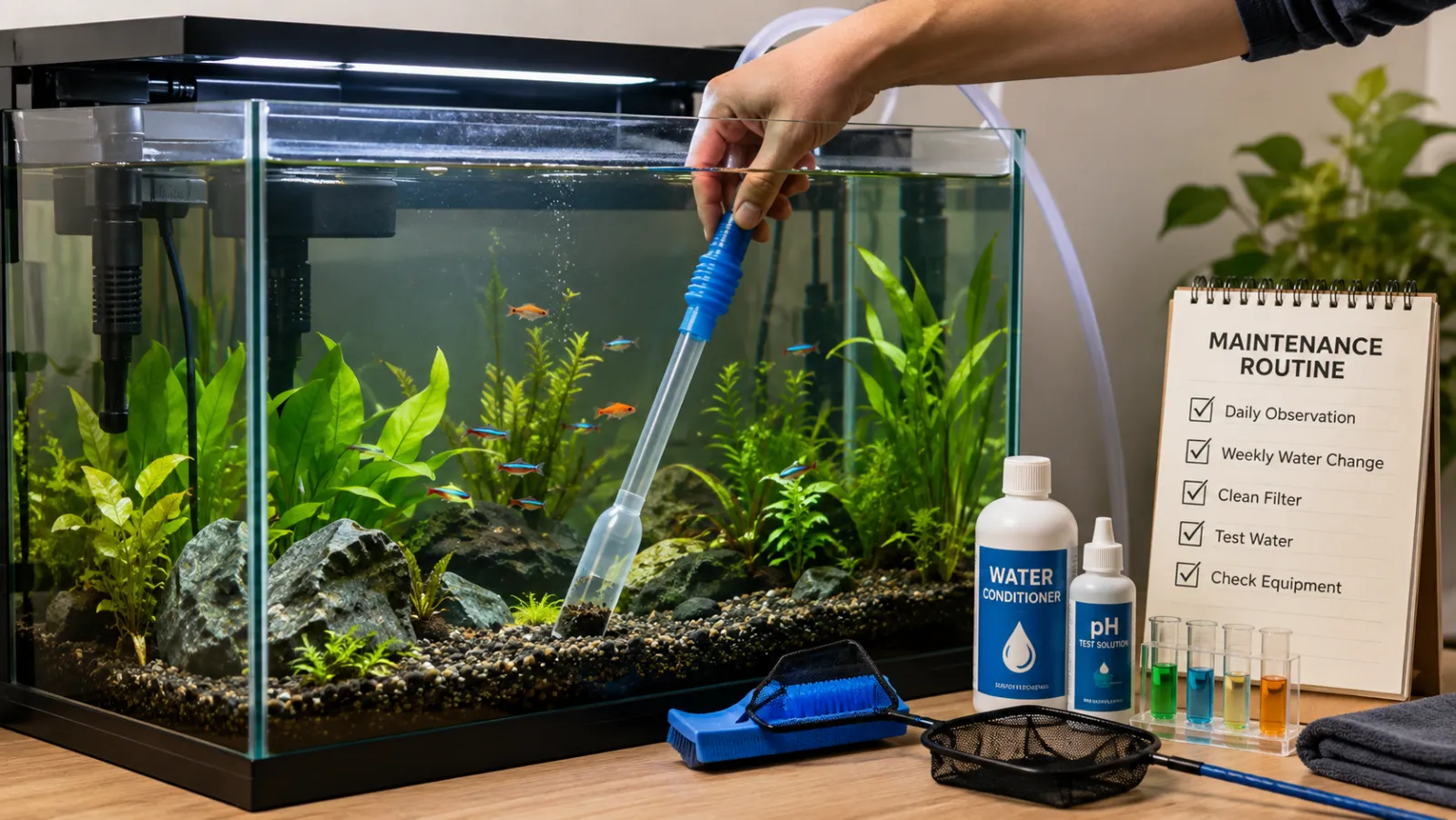
A Simple Aquarium Water-Testing Routine for Beginners
A practical routine can make water testing much easier.
Daily:
Observe fish, check temperature, and make sure equipment is functioning.
Weekly:
Check important water parameters according to your aquarium's needs and maintenance routine.
During cycling:
Test ammonia and nitrite regularly and track the progression of the nitrogen cycle.
After adding livestock:
Monitor ammonia and nitrite more closely.
After unusual events:
Test the water following filter failure, major maintenance, illness, unexpected deaths, or other significant changes.
Monthly:
Review your records and look for trends in nitrate, pH, hardness, and other relevant parameters.
Your exact routine should depend on your aquarium rather than following a single rule for every tank.
Final Thoughts
Learning how to test aquarium water is one of the best skills a beginner can develop. It helps you understand what is happening beneath the surface and allows you to detect problems before they become serious.
Start by learning the most important parameters for your aquarium: ammonia, nitrite, nitrate, and pH. Add temperature, GH, KH, salinity, phosphate, or other species-specific tests when they are relevant to your setup.
Use a reliable testing method, follow the instructions carefully, record your results, and learn what normal looks like for your aquarium.
Most importantly, do not focus on chasing perfect numbers. Stable, appropriate conditions are generally more useful than constantly changing the water in pursuit of a specific reading.
For aquarium keepers across North America, understanding your local source water can also make a major difference because water chemistry varies between communities.
Regular testing, combined with responsible feeding, appropriate water changes, proper filtration, suitable stocking, and careful observation, gives you the information needed to maintain a healthier aquarium.
The water may look clear, but your test kit can tell you what your eyes cannot. That knowledge is a powerful part of responsible fish keeping.