Cloudy aquarium water is one of the most common problems fish keepers encounter. You may set up your aquarium carefully, add your decorations and plants, start the filter, and then suddenly notice that the water looks white, gray, green, or hazy. It can be frustrating, especially when you have just spent time cleaning and maintaining the tank.
The good news is that cloudy water does not always mean your aquarium is unhealthy. Cloudiness can have several causes, ranging from harmless temporary changes to problems that require immediate attention.
Bacterial blooms, excess food, accumulated waste, disturbed substrate, algae, poor filtration, and changes in the aquarium's biological balance can all contribute to cloudy water. The key is to identify the cause rather than repeatedly cleaning the entire tank.
For aquarium owners, especially beginners, understanding why water becomes cloudy makes troubleshooting much easier. By checking water parameters, reviewing feeding habits, maintaining filtration, and controlling waste, you can usually determine what is happening and take the right steps.
1. What Does Cloudy Aquarium Water Mean?
Cloudy water simply means that tiny particles or microorganisms are suspended in the water, reducing its normal clarity.
The appearance can vary considerably.
White or milky water: Often associated with bacterial blooms, particularly in new aquariums.
Green water: Commonly associated with free-floating algae.
Yellow or brown water: Can result from dissolved organic material, tannins from natural wood, or accumulated waste.
Gray or dusty water: May appear after disturbing the substrate or adding new gravel or decorations.
The color and timing of the cloudiness can provide useful clues about the underlying cause.
Instead of immediately performing a large cleaning session, consider when the cloudiness appeared, what recently changed in the aquarium, and whether your fish are behaving normally.
2. Check Your Water Parameters First
When aquarium water becomes cloudy unexpectedly, testing the water should be one of your first steps.
Water can look cloudy because of harmless particles, but cloudiness can also occur alongside water-quality problems.
Test the parameters that are relevant to your aquarium, particularly:
- Ammonia
- Nitrite
- Nitrate
- pH
- Temperature
Ammonia and nitrite are especially important because elevated levels can be dangerous to fish.
If ammonia or nitrite is present where it should not be, investigate possible causes such as overfeeding, decaying organic matter, an immature biological filter, excessive stocking, or filter problems.
Do not rely only on what the water looks like. Some of the most serious aquarium water-quality problems are invisible.
Regular testing is therefore useful even when the water appears crystal clear.
3. A Bacterial Bloom May Cause Cloudy Water
One of the most common causes of cloudy water in a new aquarium is a bacterial bloom.
When an aquarium is first established, populations of beneficial microorganisms are still developing. Changes in available nutrients and organic material can cause free-floating bacteria to multiply rapidly, making the water appear white or milky.
This can happen during the initial cycling process or after a significant change to the aquarium.
For example, a bacterial bloom may occur after:
- Setting up a new aquarium
- Adding too many fish
- Overfeeding
- Adding significant amounts of organic material
- Disturbing the biological filter
- Cleaning or replacing too much filter media
A bacterial bloom does not necessarily mean that something has gone terribly wrong.
The important thing is to monitor the aquarium's water parameters and fish behavior rather than trying to eliminate the cloudiness through aggressive cleaning.
In many cases, the aquarium becomes clearer as the biological system stabilizes.
4. Review Your Feeding Practices
Overfeeding is a major contributor to aquarium water-quality problems.
When fish receive more food than they can consume, leftover food sinks into the substrate or remains suspended in the water. As it decomposes, it contributes organic waste and can encourage microbial growth.
Ask yourself:
Are fish regularly leaving food behind?
Are you feeding larger portions than necessary?
Is food accumulating on the bottom?
Has feeding increased recently?
If the answer is yes, adjust your feeding routine.
Offer an appropriate amount of food based on your fish species, size, and dietary requirements. Smaller portions are often easier for aquarium keepers to manage than large feedings.
Remove obvious uneaten food when necessary.
Reducing excess food can improve water quality and reduce the likelihood of repeated cloudiness.
5. Remove Excess Waste
Cloudy water can also be linked to accumulating organic matter.
Fish waste, dead leaves, uneaten food, and other decomposing material can release nutrients and particles into the water.
Inspect the aquarium carefully for:
- Uneaten food
- Fish waste
- Dead fish or other livestock
- Decaying plant leaves
- Decomposing organic material
- Excess debris in the substrate
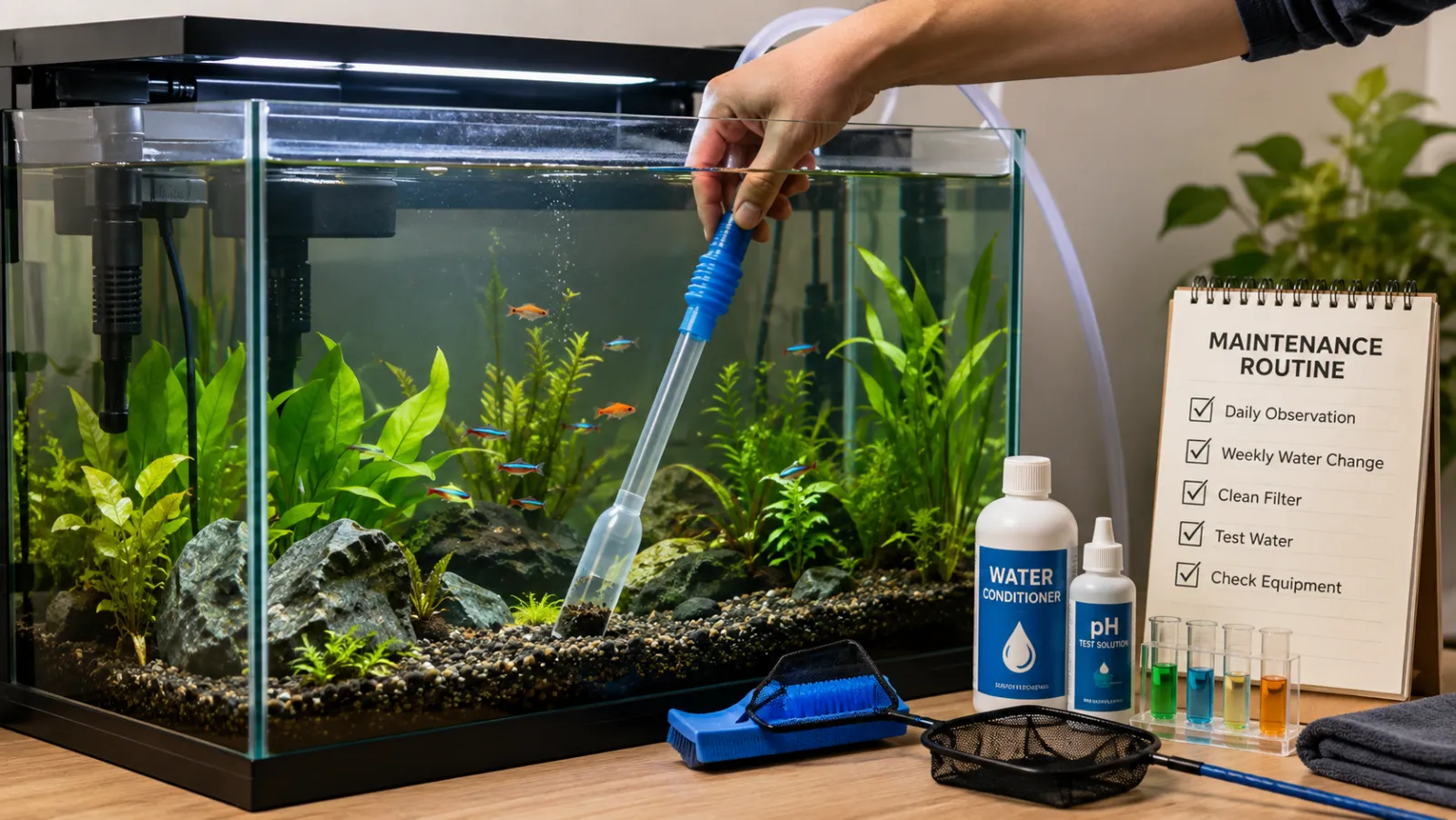
Use an aquarium net or siphon to remove visible waste.
A gravel vacuum can be particularly helpful during a partial water change because it allows you to remove debris that has settled between pieces of substrate.
The goal is not to sterilize the aquarium. Instead, remove excessive organic material while preserving the established biological environment.
6. Inspect Your Aquarium Filter
Filtration problems are another common cause of cloudy water.
Your filter helps remove suspended particles and supports biological filtration. If the filter is clogged, incorrectly installed, undersized, or experiencing reduced water flow, water clarity can suffer.
Check whether:
- The filter is running normally
- Water is flowing through the media
- The intake is blocked
- The filter sponge is heavily clogged
- The impeller needs attention
- Tubing is obstructed
- Filter media is positioned correctly
If mechanical filter media is packed with debris, it may not be able to capture particles effectively.
Clean reusable media appropriately, following the manufacturer's instructions. When biological media is involved, avoid unnecessarily replacing or aggressively cleaning all of it at once because beneficial bacteria live on these surfaces.
A filter needs to be functional, but it does not need to look perfectly clean.
7. Substrate Disturbance Can Temporarily Cloud the Water
Sometimes cloudy water is simply the result of something you recently changed.
Adding new gravel or sand, moving decorations, planting, or performing significant substrate work can release fine particles into the water.
This type of cloudiness is often temporary.
For example, newly added substrate may contain fine dust that becomes suspended when water is poured into the aquarium. Similarly, aggressively vacuuming or moving decorations can disturb accumulated particles.
To reduce this problem:
- Rinse suitable new substrate thoroughly before use when appropriate.
- Add water slowly.
- Avoid unnecessarily disturbing the substrate.
- Use appropriate filtration to capture suspended particles.
- Give the aquarium time to settle.
A temporary haze following aquarium maintenance is often very different from cloudiness that appears alongside high ammonia or severe fish stress.
8. Green Cloudy Water May Be Free-Floating Algae
Not all cloudy water is caused by bacteria.
If the water has a distinctly green appearance, you may be dealing with free-floating algae, sometimes called green water.
This type of algae can multiply rapidly when conditions provide abundant light and nutrients.
Possible contributing factors include:
- Excessive aquarium lighting
- Direct sunlight
- High nutrient levels
- Overfeeding
- Excess organic waste
Reducing excessive light and addressing the nutrient source can help.
Avoid placing the aquarium in intense direct sunlight. Also review your feeding and water-change routine.
Simply cleaning the glass will not solve green water because the algae are suspended throughout the water rather than attached only to surfaces.
9. Check Whether Your Aquarium Is Overstocked
A tank containing too many fish can become difficult to keep clear and stable.
More livestock means more waste production and greater demand on biological filtration.
If cloudy water repeatedly appears after adding new fish, the increased biological load may be part of the problem.
Consider:
- Current fish population
- Adult size of each species
- Aquarium volume
- Filter capacity
- Feeding levels
- Water test results
Adding fish gradually is generally safer than introducing a large number at once, particularly in a newer aquarium.
Even an established biological filter has limits.
Overstocking can contribute not only to cloudy water but also to elevated ammonia, nitrite, nitrate, oxygen demand, and general stress.
10. Perform an Appropriate Partial Water Change
A partial water change can be helpful when cloudiness is associated with waste accumulation or poor water quality.
Rather than automatically replacing most or all of the aquarium water, perform a suitable partial water change based on the condition of the tank and your test results.
During the process:
- Remove an appropriate amount of aquarium water.
- Vacuum areas of the substrate where waste has accumulated.
- Remove visible debris.
- Prepare replacement water properly.
- Make sure replacement water is appropriately conditioned.
- Keep the temperature reasonably close to the aquarium's existing temperature.
- Refill the aquarium carefully.
The purpose of the water change is to improve water quality without creating unnecessary instability.
If ammonia or nitrite is elevated in a stocked aquarium, the situation should be treated more urgently, and water changes may be an important part of correcting the problem.
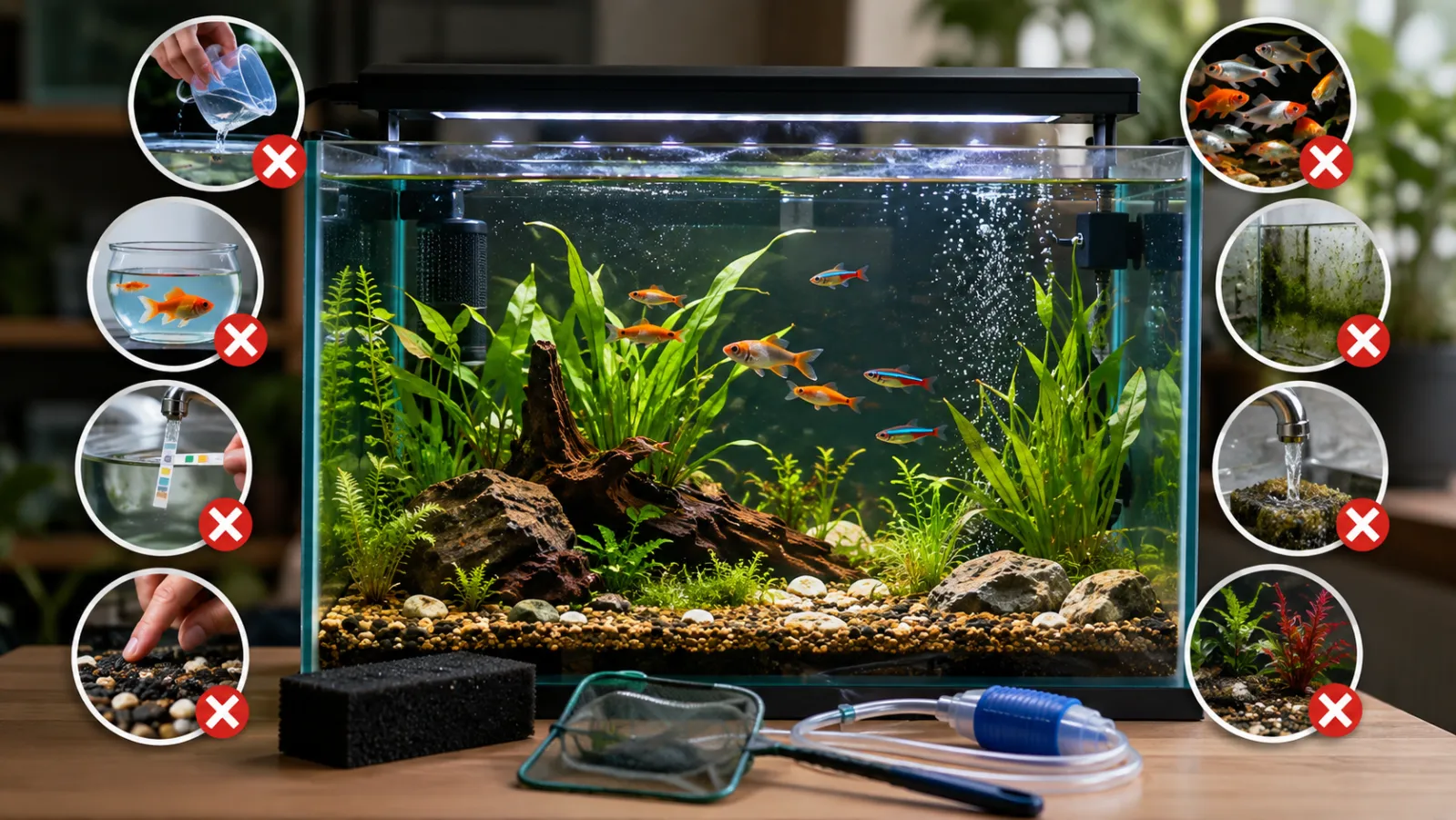
11. Avoid Deep Cleaning the Entire Aquarium
When people see cloudy water, their first instinct may be to empty the aquarium and scrub everything.
This is usually not the best routine solution.
A mature aquarium contains beneficial microorganisms on the filter media, substrate, decorations, and other surfaces. Completely stripping the aquarium can disturb this biological environment.
Avoid:
- Emptying the entire aquarium unnecessarily
- Scrubbing every surface
- Replacing all filter media simultaneously
- Washing biological media aggressively
- Using household soaps or detergents
Instead, focus on identifying the cause of the cloudiness and correcting the underlying problem.
A stable aquarium does not need to be completely reset every time something changes.
12. New Aquariums Need Extra Patience
Cloudy water is especially common in newly established aquariums.
A new tank is still developing its biological filtration system. The microbial community is changing as the aquarium establishes the nitrogen cycle.
During this period, water may temporarily become cloudy.
The best approach is to:
- Test ammonia and nitrite
- Monitor nitrate
- Avoid overfeeding
- Avoid adding livestock too quickly
- Maintain appropriate filtration
- Remove excess waste
- Allow the biological system to mature
Do not assume that adding more fish will make a new aquarium look or function more naturally. Additional livestock increases the waste load and can make cycling problems worse.
Patience is one of the most valuable aquarium-care skills a beginner can develop.
13. Watch Your Fish for Signs of Stress
Cloudy water itself is not always dangerous, but the conditions causing it may be.
Pay attention to fish behavior.
Warning signs can include:
- Rapid breathing
- Gasping at the surface
- Unusual hiding
- Loss of appetite
- Clamped fins
- Lethargy
- Erratic swimming
- Sudden aggression
If fish appear distressed, do not focus only on making the water look clearer.
Check water parameters immediately and investigate the underlying cause.
A visually attractive aquarium is not necessarily a healthy aquarium. Fish behavior and water chemistry are much more useful indicators of overall condition.
14. Consider Your Cleaning Routine
If cloudy water keeps returning, review your maintenance routine rather than treating each episode as a separate problem.
Ask:
How often are water changes performed?
Are you regularly vacuuming areas where waste accumulates?
Are you overfeeding?
Is the aquarium overstocked?
Is the filter working properly?
Are you replacing too much filter media at once?
Is the aquarium receiving too much light?
Repeated cloudiness often means an underlying factor has not been addressed.
Keeping a simple aquarium log can help you identify patterns. Record water tests, water changes, feeding changes, new livestock, filter maintenance, and other significant events.
Over time, these records can help you understand exactly what triggers problems in your aquarium.
Common Causes of Cloudy Aquarium Water
Here are some of the most common possibilities:
Bacterial bloom: Frequently seen in new or biologically disrupted aquariums.
Overfeeding: Excess food decomposes and increases organic waste.
Fish waste: High stocking levels can produce more waste than the system can comfortably process.
Substrate disturbance: Fine particles can become suspended after cleaning or rearranging the tank.
Poor filtration: A clogged, inadequate, or malfunctioning filter may not remove suspended particles effectively.
Free-floating algae: Green water can result from excessive light and nutrients.
Decaying material: Dead fish, plants, or organic matter can contribute to water-quality problems.
Identifying which situation matches your aquarium is the first step toward solving it.
A Simple Troubleshooting Process
When aquarium water suddenly becomes cloudy, work through the problem methodically.
Step 1: Look at the color of the cloudiness.
Step 2: Test ammonia, nitrite, nitrate, pH, and temperature as appropriate.
Step 3: Check for uneaten food and visible waste.
Step 4: Inspect the fish for unusual behavior or signs of stress.
Step 5: Check the filter and confirm that water is flowing correctly.
Step 6: Review recent changes, such as adding fish, changing substrate, increasing feeding, or cleaning the filter.
Step 7: Perform appropriate partial maintenance based on the test results and condition of the aquarium.
Step 8: Continue monitoring rather than repeatedly dismantling the tank.
This approach helps you treat the cause rather than just the appearance of the problem.
Final Thoughts
Cloudy aquarium water can be frustrating, but it is usually a symptom rather than a mystery. The most important thing is to avoid panicking and immediately performing an aggressive deep clean.
Start by checking your water parameters. Review your feeding habits and remove excess food or waste. Inspect the filter and make sure it is functioning correctly. Consider whether recent substrate disturbance, new livestock, excessive lighting, or biological changes could explain the cloudiness.
For a new aquarium, a temporary bacterial bloom may simply be part of the process of establishing a stable biological system. In other cases, cloudy water can point toward overfeeding, poor filtration, excessive waste, algae, or water-quality problems that require attention.
The goal is not to keep your aquarium artificially spotless. The goal is to maintain a stable, healthy aquatic environment.
With regular testing, appropriate water changes, responsible feeding, effective filtration, and careful observation, you can troubleshoot cloudy water more confidently and keep your aquarium healthier over the long term.