Keeping aquarium water clean and healthy is one of the most important responsibilities of any fish keeper. Clear-looking water may seem like a sign that everything is fine, but aquarium water can still contain harmful levels of ammonia, nitrite, nitrate, or other pollutants that are invisible to the eye. Poor water quality is one of the most common aquarium problems and can quickly affect fish health, behavior, growth, and overall well-being.
Whether you have a small freshwater aquarium, a large community tank, a planted aquarium, or a saltwater setup, maintaining good water quality should be part of your regular routine. The good news is that healthy aquarium water does not require complicated maintenance. A few consistent habits can prevent many common problems and create a stable environment for your fish and aquatic life.
Here are the most important steps for keeping aquarium water clean, clear, and healthy.
1. Test Your Aquarium Water Regularly
One of the easiest ways to maintain healthy aquarium water is to test it regularly. Water testing allows you to find problems before your fish begin showing signs of stress.
The most important parameters for many freshwater aquariums are:
Ammonia: Ammonia is highly toxic to fish. It is produced when fish waste, uneaten food, and decaying organic material break down. In a properly established aquarium, ammonia should normally be at or near zero.
Nitrite: Nitrite is another toxic compound created during the aquarium's biological filtration process. A healthy established tank should have zero nitrite.
Nitrate: Nitrate is less toxic than ammonia and nitrite, but it can build up over time. Regular water changes help control nitrate levels.
pH: pH measures how acidic or alkaline the water is. Different fish species have different preferences, so maintaining a stable pH that suits your fish is often more important than constantly trying to achieve a specific number.
Temperature: Water temperature should remain appropriate and stable for the species you keep. Sudden temperature changes can stress fish and affect their immune systems.
Testing once a week is a practical starting point for many aquariums. Newly established tanks, tanks with recent problems, or heavily stocked aquariums may require more frequent testing.
Do not wait until the water looks dirty before testing it. Clear water can still have unsafe chemistry.
2. Perform Regular Water Changes
Water changes are one of the most effective ways to maintain good aquarium water quality. Even when your filter is working correctly, dissolved waste and nitrate can gradually accumulate.
For many home aquariums, a partial water change of around 10% to 25% per week is a useful maintenance routine. The exact amount and frequency should depend on the tank size, stocking level, filtration, feeding habits, plant growth, and the needs of the species.
A proper water change involves removing a portion of the old water and replacing it with appropriately prepared new water.
Before adding tap water to the aquarium, use a suitable aquarium water conditioner to neutralize chlorine and chloramine when required. These chemicals are commonly used in municipal water supplies and can damage fish and beneficial bacteria.
When performing a water change:
- Unplug equipment that could be damaged while the water level is low.
- Remove the appropriate amount of aquarium water.
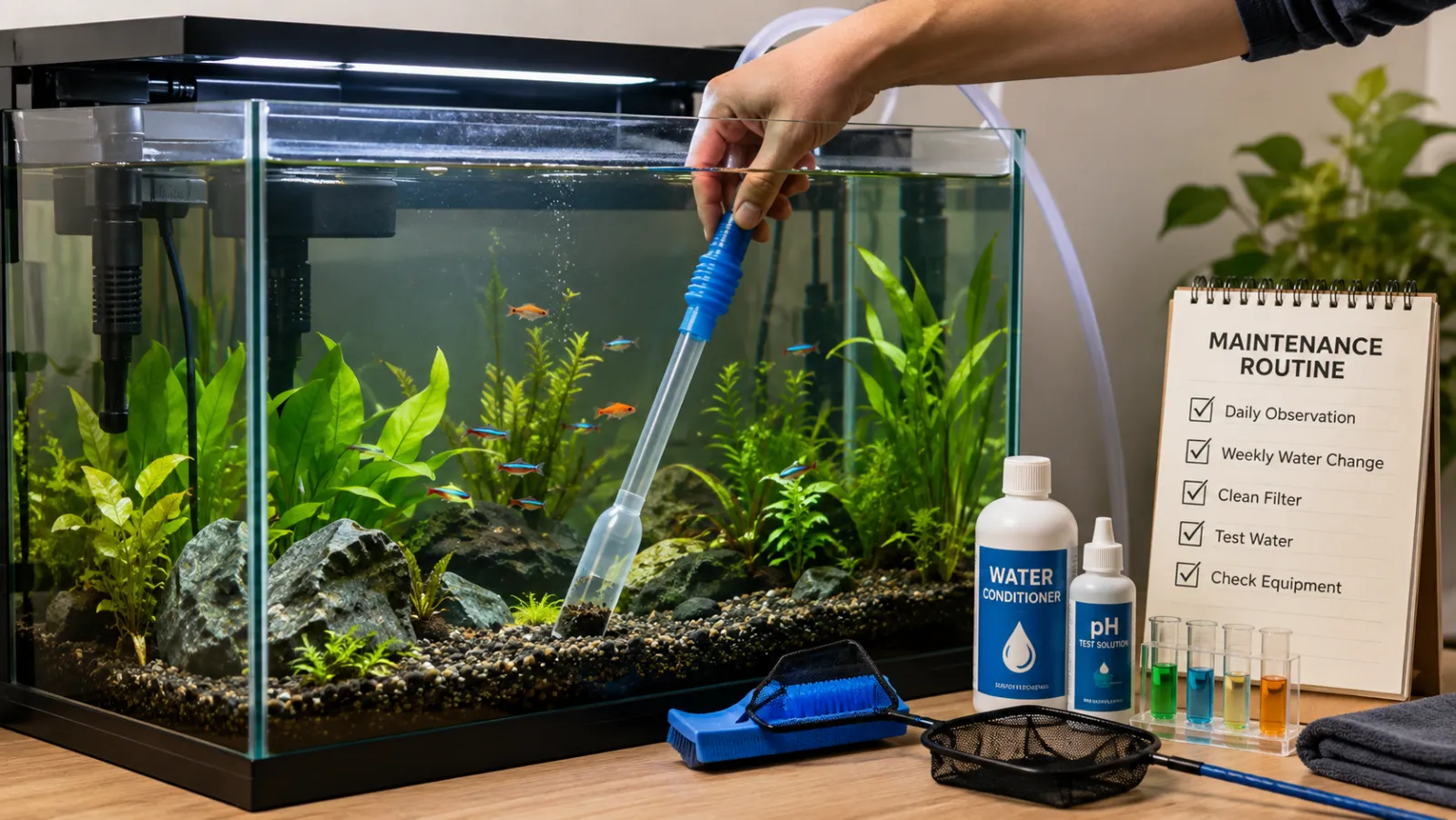
- Use a gravel vacuum to remove debris from the substrate.
- Prepare replacement water with the correct temperature.
- Treat tap water with a suitable water conditioner.
- Add the new water slowly to avoid disturbing fish and plants.
- Restart equipment and check that everything is operating normally.
Avoid replacing all the water at once unless there is a serious emergency that requires it. Large, sudden changes can cause unnecessary stress and may drastically alter temperature or water chemistry.
Consistency is usually more beneficial than large, irregular cleaning sessions.
3. Maintain the Filtration System
Your aquarium filter is one of the most important pieces of equipment in the entire tank. A good filtration system helps remove physical debris, supports beneficial bacteria, and improves water movement.
Aquarium filtration generally involves three types of filtration:
Mechanical filtration removes visible particles such as uneaten food and debris.
Biological filtration provides surfaces where beneficial bacteria can live. These bacteria help process toxic waste compounds as part of the nitrogen cycle.
Chemical filtration uses materials such as activated carbon or other specialized media to remove certain dissolved substances. Its usefulness depends on the aquarium and the specific maintenance goal.
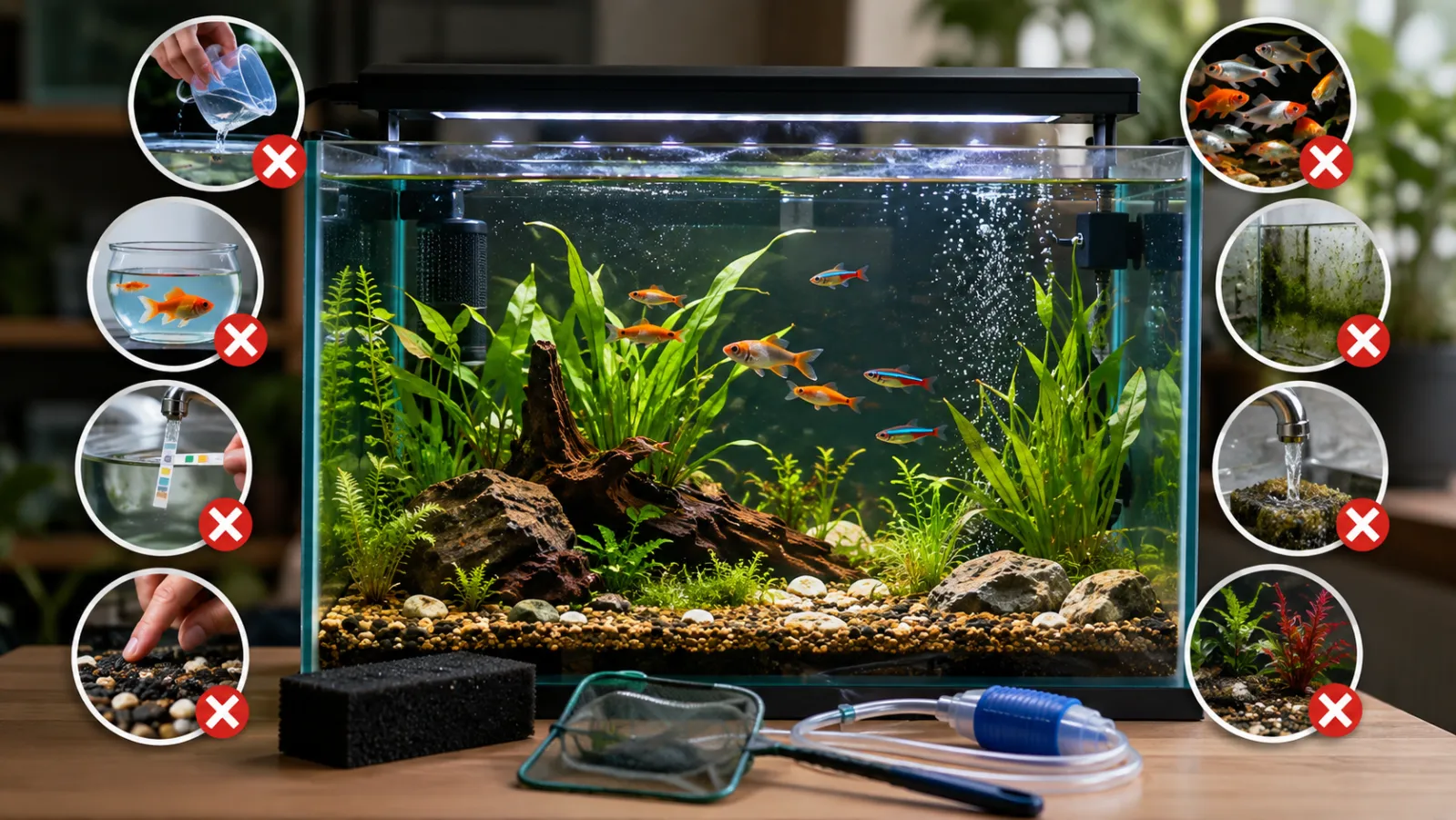
One common mistake is cleaning filter media too aggressively. If you wash biological media under untreated tap water, you may damage or reduce the beneficial bacterial colonies that help maintain biological stability.
Instead, when appropriate, rinse reusable filter media gently in water removed from the aquarium during a water change. Follow the manufacturer's recommendations for replacing disposable cartridges or other filtration materials.
Also check the filter regularly for:
- Reduced water flow
- Blocked intake tubes
- Dirty filter sponges
- Air trapped in the system
- Unusual noises
- Damaged or worn components
A filter does not replace water changes, but proper filtration makes routine maintenance much easier and helps create a more stable environment.
4. Remove Uneaten Food and Fish Waste
Overfeeding is one of the most common causes of aquarium water quality problems.
It is easy to give fish too much food, especially when they appear excited at feeding time. However, uneaten food eventually breaks down and adds organic waste to the aquarium.
Feed only what your fish can reasonably consume within a short period. The exact amount depends on the species and the type of food, but smaller controlled portions are generally safer than large amounts.
If food remains on the substrate after feeding, remove it with a small net or aquarium siphon.
You should also remove visible waste and decaying plant material when appropriate. The goal is not to make the aquarium completely sterile. Beneficial microorganisms are an important part of a healthy aquarium ecosystem. Instead, focus on preventing excessive waste from accumulating.
A clean aquarium is not necessarily one where every surface is spotless. It is one where waste is controlled and the biological system remains balanced.
5. Avoid Overstocking Your Aquarium
The number of fish in an aquarium has a major effect on water quality.
More fish produce more waste, consume more oxygen, and place greater demands on filtration and maintenance. A tank that looks attractive with a large number of fish can quickly become difficult to manage if the biological filtration system cannot keep up.
Before adding any fish, consider:
- Adult fish size
- Swimming and territorial behavior
- Filtration capacity
- Aquarium volume
- Feeding requirements
- Compatibility
- Waste production
- Maintenance needs
Do not choose fish based only on their size at the store. Many species grow significantly larger as adults.
Overstocking can lead to poor water quality, increased aggression, stress, and oxygen problems. A moderately stocked aquarium is often easier to maintain and provides a healthier environment for the fish.
6. Do Not Rely on Clear Water Alone
One of the most important things to understand about aquarium maintenance is that clear water does not automatically mean healthy water.
Water can look completely transparent while containing harmful chemicals. At the same time, slightly cloudy water does not always mean the aquarium is unsafe.
For example, a new aquarium may experience temporary bacterial cloudiness as the biological system becomes established. Rather than reacting by completely dismantling the aquarium, it is usually better to understand what is causing the change and test the water.
Use your test results, fish behavior, maintenance history, and equipment performance together to evaluate aquarium health.
Watch your fish for signs such as:
- Rapid breathing
- Gasping near the surface
- Clamped fins
- Unusual hiding
- Loss of appetite
- Sudden lethargy
- Abnormal swimming
- Increased aggression
Behavioral changes can sometimes be an early warning that something is wrong with the aquarium environment.
7. Clean the Substrate Without Destroying the Ecosystem
The substrate at the bottom of an aquarium can collect uneaten food, fish waste, plant debris, and other organic material.
A gravel vacuum or aquarium siphon can help remove this buildup during water changes.
However, cleaning should be done thoughtfully. Beneficial microorganisms live on aquarium surfaces, including the substrate. You do not need to sterilize the entire tank every time you perform maintenance.
Focus on visibly dirty areas and rotate through sections when appropriate, especially in established aquariums.
For planted tanks, be particularly careful around plant roots. Excessive disturbance can damage plants or release debris into the water.
A balanced approach removes waste while preserving the biological stability of the aquarium.
8. Maintain Healthy Water Movement and Oxygen Levels
Good water circulation helps distribute oxygen and prevents areas of stagnant water from developing.
Your filter should create enough movement for your aquarium setup without producing excessive current for species that prefer gentle water.
Surface movement is especially important because gas exchange takes place at the water's surface. In some aquariums, an air stone or additional circulation may help improve oxygenation.
Oxygen demand can increase when:
- The aquarium is heavily stocked
- Water temperatures are higher
- Organic waste levels are elevated
- The tank has poor circulation
- Fish are active or stressed
Regularly check that the filter outlet and intake are unobstructed. If water movement suddenly decreases, investigate the filter before the problem becomes serious.
9. Keep Aquarium Temperature Stable
Temperature is another important part of water quality and fish health.
Different species have different temperature requirements, so research the needs of your specific fish rather than choosing a temperature based on general aquarium advice.
A reliable aquarium thermometer is a simple but useful tool. Check it regularly, especially during seasonal temperature changes.
In colder homes, a properly sized heater may be necessary for tropical fish. During warmer periods, aquariums may require additional cooling or improved ventilation.
Avoid placing the aquarium where it receives intense direct sunlight, because this can contribute to temperature fluctuations and excessive algae growth.
The goal is not simply to reach a suitable temperature once. The goal is to keep it stable.
10. Control Algae Without Over-Cleaning
A small amount of algae is normal in many aquariums. Problems arise when algae grow excessively and interfere with the appearance or health of the tank.
Excess algae can be encouraged by too much light and high nutrient levels.
To control algae:
- Avoid excessive lighting
- Keep aquarium lights on a consistent schedule
- Remove algae from glass and decorations
- Avoid overfeeding
- Perform regular water changes
- Maintain healthy filtration
- Consider live plants where appropriate
Do not depend on algae-control products as a replacement for good aquarium maintenance. Addressing the underlying causes is usually more effective.
11. Be Careful When Cleaning Aquarium Equipment
Aquarium equipment should be cleaned regularly, but excessive cleaning can sometimes create new problems.
Never use household soaps, detergents, or chemical cleaners on aquarium equipment that will come into contact with fish or aquarium water.
When cleaning decorations, filter components, or other items, use aquarium-safe methods. Some equipment can simply be rinsed or gently scrubbed with water.
Clean one part of the system at a time rather than stripping everything down unnecessarily. This helps preserve beneficial microbial communities and reduces stress on the aquarium's biological system.
12. Establish a Simple Maintenance Routine
The easiest way to keep aquarium water healthy is to create a routine and stick to it.
A basic maintenance schedule might look like this:
Daily:
Check fish behavior, equipment operation, and feeding.
Weekly:
Test important water parameters, inspect the filter, remove debris, and perform a partial water change as needed.
Monthly:
Inspect equipment more thoroughly, check tubing and filter components, and review your feeding, stocking, and maintenance routine.
The exact schedule will vary depending on the aquarium. A heavily stocked tank may need more maintenance than a lightly stocked planted aquarium.
Keeping a simple aquarium log can also help. Record water test results, water changes, equipment maintenance, and any unusual fish behavior. Over time, this can help you identify patterns before they become bigger problems.
Common Aquarium Water Problems and What They May Mean
Cloudy water: May be related to bacterial blooms, excess organic material, overfeeding, or a newly established aquarium.
Bad smell: Can indicate excessive waste, decaying material, or poor circulation.
High ammonia: Often associated with an immature biological filter, overstocking, dead organisms, or decomposing organic matter.
High nitrite: Usually indicates that the biological filtration process is not keeping up with the production of waste.
High nitrate: Often means that waste has accumulated and the aquarium needs better maintenance, water changes, or stocking adjustments.
Excessive algae: Commonly linked to too much light and excess nutrients.
The key is to identify the cause instead of simply treating the visible symptom.
Final Thoughts
Keeping aquarium water clean and healthy does not require constant cleaning or complicated equipment. The most effective approach is a consistent maintenance routine based on testing, water changes, proper filtration, responsible feeding, and waste management.
Test your water regularly so you know what is happening beneath the surface. Perform appropriate partial water changes to control accumulating waste. Keep the filtration system functioning properly and protect the beneficial bacteria that support the nitrogen cycle. Remove uneaten food, control waste, and avoid overstocking the aquarium.
Most importantly, learn to look beyond crystal-clear water. A healthy aquarium is one where water chemistry is stable, fish are behaving normally, equipment is functioning correctly, and maintenance is performed consistently.
For aquarium owners across North America, where municipal water conditions, seasonal temperatures, and household environments can vary significantly, developing a dependable maintenance routine is one of the best investments you can make in your fish's long-term health.
With regular care and attention, your aquarium can become more than a beautiful display. It can provide a stable, healthy aquatic environment where your fish and plants can thrive for years to come.